


FIGURE 3. Stereo representations of AR interactions with R-3 and S-1.
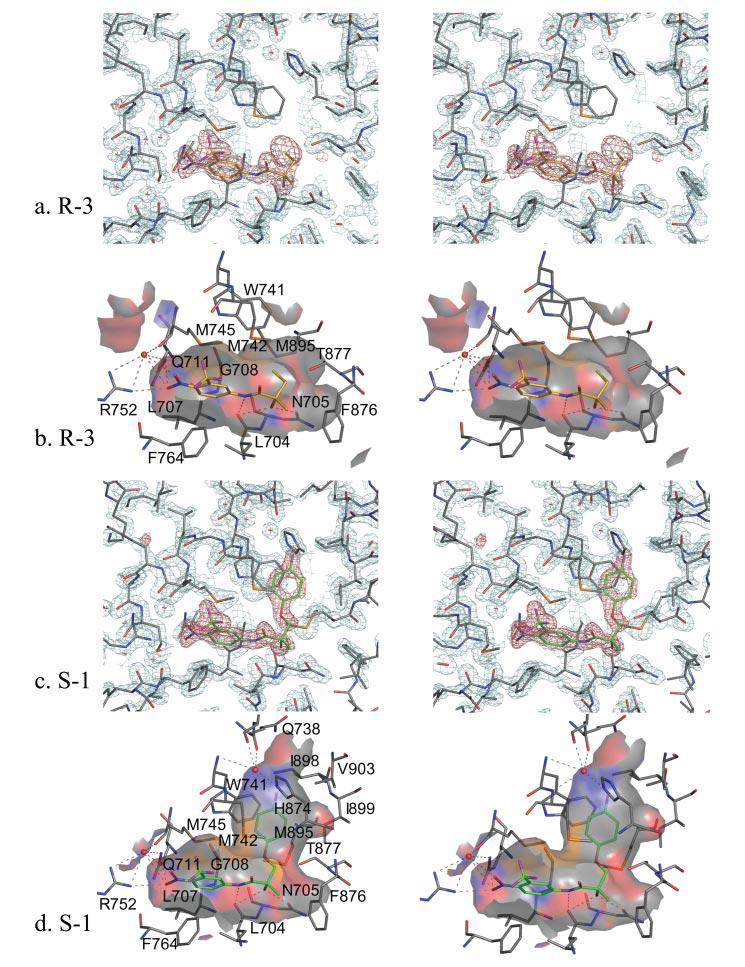
a, WT-R-3 complex fit into the 2Fo − Fc electron density maps contoured at the 2σ level (cyan) with R-3 shown in the Fo − Fc simulated annealing omit map contoured at the 4σ level (red). AR carbons, gray; R-3 carbons, gold; oxygen, red; nitrogen, blue; sulfur, orange; bromine, yellow. b, AR surface contacts with the R-3 binding pocket. Possible hydrogen bonds within 3.5 Å are represented by dashed lines. Notice that Gln-711 and Arg-752 hydrogen bond with the nitro group of R-3. Leu-704 and Asn-705 also form hydrogen bonds with R-3. Also notice the hydrophobic contacts from Trp-741, Met-742, and Met-895 with the R-3 bromine atom. Electron density for Trp-741 in the WT-R-3 structure cannot be visualized at the 2σ level, but electron density is more evident at lower σ levels. c, WT-S-1 complex fit into the 2Fo − Fc electron density maps contoured at the 2σ level (cyan) with S-1 (carbons in green) shown in the Fo − Fc simulated annealing omit map contoured at the 4σ level (red). d, AR surface contacts with the S-1 binding pocket. Similar hydrogen bonds to the AR are present in S-1 as with R-3. Notice the increased size of the S-1 binding pocket as compared with R-3 due to the S-1 B-ring. A water molecule hydrogen bonds to the His-874 side chain and backbone atoms of helices 4 and 5 within 3.0 Å of the B-ring fluorine atom, similar to that seen in the W741L-R-bicalutamide complex. Also notice the clear electron density for Trp-741 at the 2σ level as compared with the R-3-bound structure, likely because of decreased mobility of Trp-741 from binding of the S-1 B-ring.