


Fig. 2.
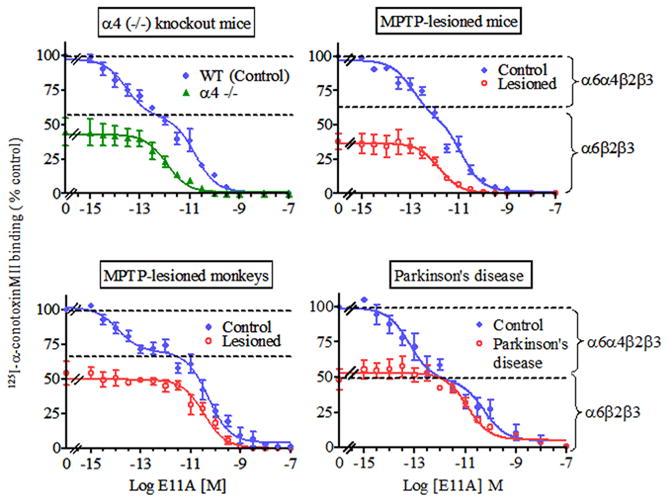
Preferential decline in the striatal α6α4β2β3 nAChR subtype in animal models (mouse and monkey) of nigrostriatal damage and Parkinson’s disease. 125I-α-conotoxinMII (0.5 nM) competition assays were performed using varying concentrations of the α-conotoxinMII analog E11A. In the upper left panel, biphasic inhibition curves (data fit best to a two site model) were obtained with E11A in the striatum of wild type mice suggesting the presence of at least two E11A-sensitive 125I-α-conotoxinMII binding sites. In contrast monophasic inhibition (data fit best to a one site model) was obtained using striatal sections from α4 nAChR null mutant mice. Since these mice do not express the α4 subunit, the remaining high affinity-binding site is most likely the α6β2β3 nAChR, while the very high affinity-binding site that is lost may represent the α6α4β2β3 subtype. The three remaining panels depict the effect of nigrostriatal damage on the nAChR subtypes in mouse, monkey and human striatum. Biphasic inhibition curves (data fit best to two site model) were obtained with E11A under control conditions. These data suggest that E11A discriminates between at least two α6β2-containing nAChR populations, a very high α6α4β2β3 and a high affinity α6β2β3 nAChR subtype. Similar competition analyses using sections from lesioned animals and Parkinson’s disease striatum yielded monophasic curves, suggesting the loss of the very high affinity E11A-sensitive α6α4β2β3 nAChR subtype. Symbols represent means ± S.E.M. of 4–8 mice, 4–6 monkeys and 5 control and 4 Parkinson’s disease cases. Reproduced in modified form with permission from reference [88]