


Figure 1.
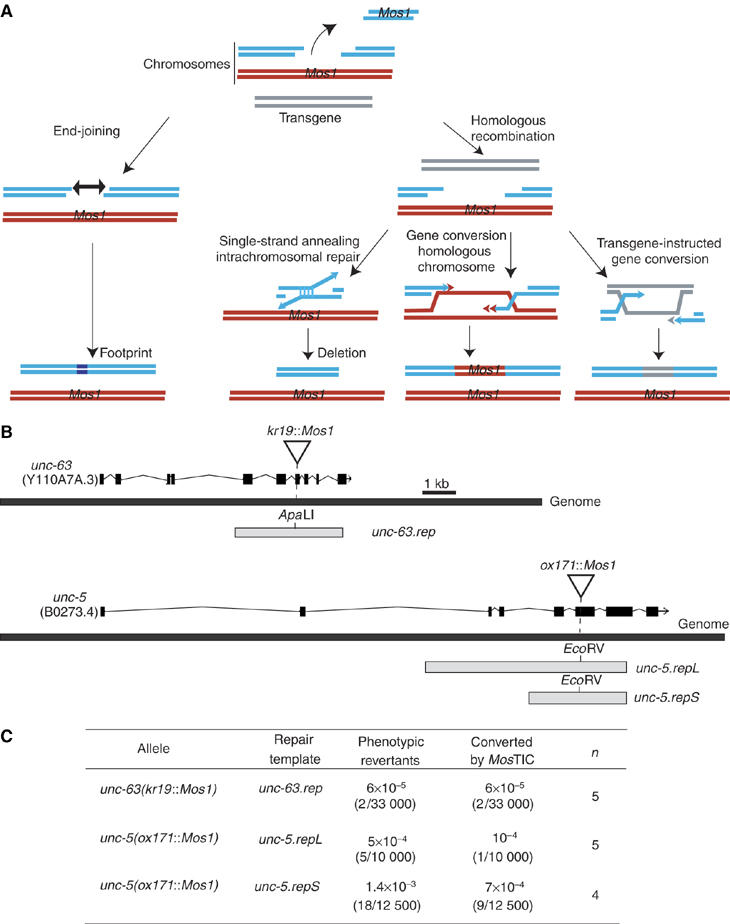
MosTIC strategy and efficiency. (A) Main pathways potentially used to repair a Mos1 excision-induced DSB during MosTIC experiments. In this example, homologous chromosomes (in red and blue) carry the same Mos1 insertion and a homologous repair template is provided on a transgene (in gray). Repair of the broken chromosome (in blue) is based either on end-joining or homologous recombination (single-strand annealing or gene conversion) (see Introduction). (B) Schematic representation of the exon/intron structure of the Mos1-containing alleles unc-63(kr19∷Mos1) and unc-5(ox171∷Mos1) with the repair templates (unc-63.rep, unc-5.repL and unc-5.repS) used in MosTIC experiments. Mos1 elements are indicated by triangles. The restriction sites ApaLI and EcoRV were introduced into the repair templates to identify MosTIC events. The repair templates did not contain enough sequences to rescue the mutant phenotypes. However, copying these sequences into the Mos1-mutated genomic loci would restore functional genes. (C) MosTIC efficiency at the unc-63 and unc-5 loci. Frequencies correspond to the number of phenotypic revertants in the progeny of transgenic animals where Mos1 excision was triggered by heat-shock. MosTIC events were identified among the phenotypic revertants by the presence of an ApaLI site (unc-63 locus) or an EcoRV site (unc-5 locus) copied into their genome. n, number of independent experiments.