


Figure 1. Recruitment of Patients and Culture Results.
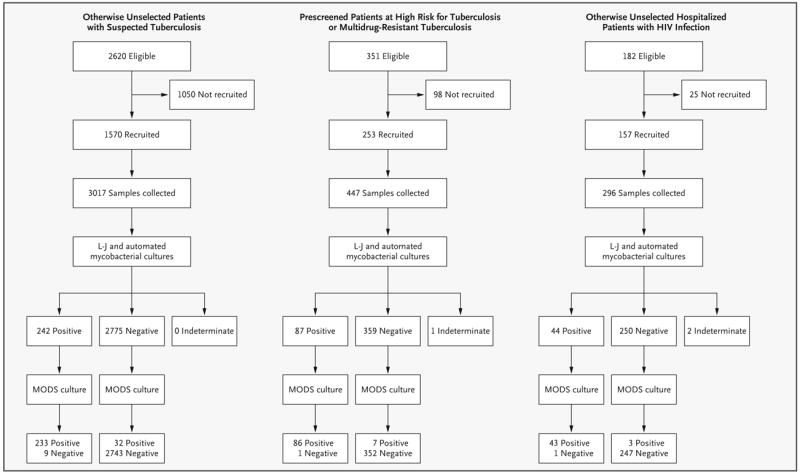
For Löwenstein–Jensen (L-J) and automated mycobacterial cultures, positive cultures were those that were positive according to either method or both; negative cultures were those that were negative according to both methods or negative according to one method and indeterminate according to the other; and indeterminate cultures were those that were indeterminate according to both methods. For patients with suspected tuberculosis, the 242 reference-standard culture-positive samples included 4 false positive samples arising from cross-contamination36 (1 in Löwenstein–Jensen culture alone, 1 in automated mycobacterial culture alone, and 2 in both automated mycobacterial culture and MODS culture), and the 32 culture-positive samples in MODS culture alone included 7 that were false positive owing to cross-contamination. For the prescreened patients at high risk for tuberculosis or multidrug-resistant tuberculosis, the 87 reference-standard culture-positive samples included 1 false positive sample in both automated mycobacterial culture and MODS culture, and the 7 samples that were culture-positive in MODS culture alone included 2 false positive cultures. The indeterminate cultures for the prescreened patients and the hospitalized patients with HIV infection were designated as such because cultures from all three methods were repeatedly contaminated by bacterial overgrowth (two with rapid-growing nontuberculous mycobacteria).