


Figure 7.
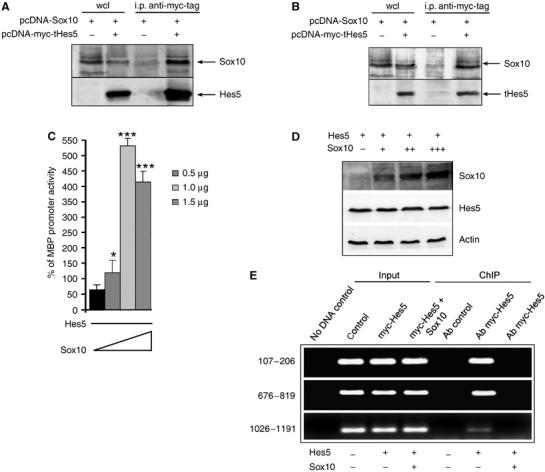
Functional interaction between Hes5 and Sox10 in the regulation of the MBP promoter. (A) Whole-cell lysates (wcl) from oligodendrocyte progenitors transfected with myc-tag Hes5 with or without Sox10 were used for co-immunoprecipitation studies, using antibodies against myc-tag for immunoprecipitation. The identity of the interacting proteins was defined by Western blot analysis, using antibodies specific for Sox10 or for myc-tagged Hes5. (B) Also, tHes5 retained the ability to bind to Sox10 as demonstrated by immunoprecipitation. (C) Luciferase reporter assay of cells cotransfected with MBP promoter driving reporter together with constant amounts of myc-tagged Hes5 plasmid (0.5 μg) and increasing amounts of Sox10 DNA (0.5, 1 and 1.5 μg) indicated that the inhibitory effect of Hes5 on the MBP promoter could be reversed by increasing concentrations of Sox10 (*P⩽0.05, ***P⩽0.0005). (D) To confirm that increasing amounts of transfected Sox10 DNA corresponded to increased protein levels, we performed a Western blot analysis of protein extracts from cultures transfected with 0.5 μg of myc-tagged Hes5 plasmid together with 0.5 μg (+), 1 μg (++) and 1.5 μg (+++) of Sox10 plasmid. (E) ChIP was performed on samples isolated from untransfected (control), Hes5 transfected or Hes5 and Sox10 cotransfected progenitors, using antibodies against myc-tag. The immunoprecipitated products were amplified using the indicated primers. Note that in the absence of Sox10, Hes5 was recruited to the regions of the MBP promoter containing N- and E-boxes. However, in the presence of high levels of Sox10, Hes5 was displaced from the promoter.