


Figure 6.
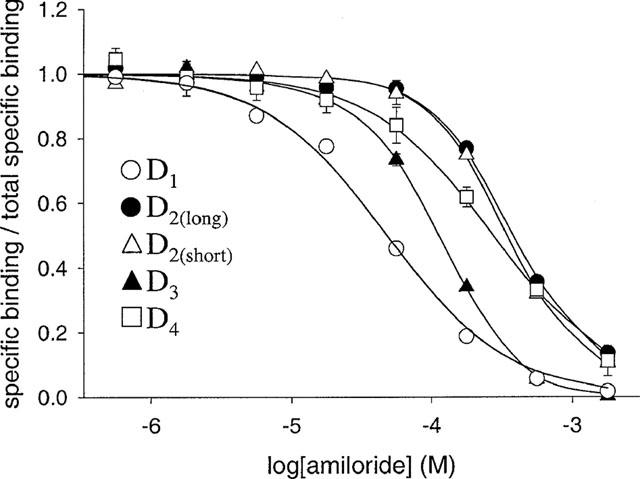
Inhibition of radioligand binding to human dopamine receptor subtypes by amiloride. Pseudo-competition experiments were performed as described in Methods, using [3H]-SCH-23390 to label D1 dopamine receptors and [3H]-spiperone to label D2-like dopamine receptors. Data were analysed as described in the legend to Figure 4. The 100% value represents the estimate of specific binding in the absence of modulator provided by analysis of data using a four parameter-logistic equation (D1−80 pM; D2(long)−23 pM; D2(short)−26–29 pM; D3−42–48 pM; D4−15 pM; corresponding values for the non-specific binding were: D1−3.1–3.6 pM, D2long−2.4–2.6 pM, D2short−1.9–3.1 pM, D3−1.8–3.4 pM, D4−2.1–2.9 pM). The total radioligand concentration was 500 pM for [3H]-SCH-23390 and 200 pM for [3H]-spiperone. Data points for the D1 subtype are the mean±s.e. (n=3) whereas data for D2-like dopamine receptors are the mean±range (n=2). The curves are the best-fits of pooled data to Equation 2 (Scheme 1, D2(long), D2(short) and D3) or Equation 3 (competitive inhibition, D4). At the D1 subtype the three binding models tested could not be statistically distinguished using these data (Table 3). The curves for these models are shown and overlie each other.