


Figure 2.
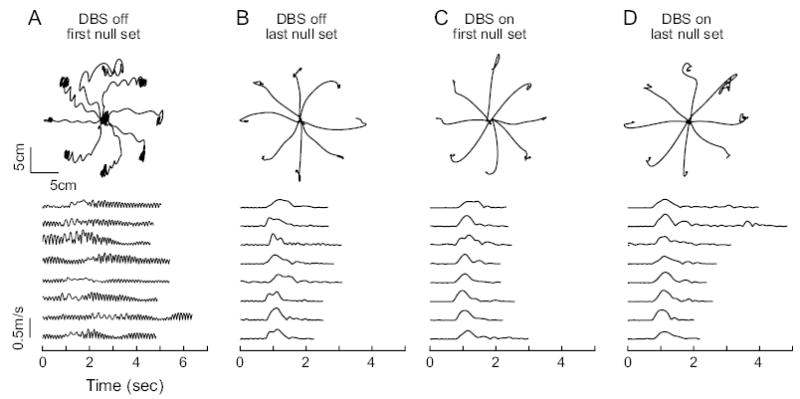
Example of reach trajectories from a DBS patient. Top row: paths of the first movements made in each direction during selected sets. Bottom row: speed profiles of the movements in the top row, corresponding to directions 0°, 45°, . . . , 315° (from top to bottom). (A) Trajectories from the first null set of the no-stimulation session. (B) Trajectories from the last null set of the no-stimulation session. (C) Trajectories from the first null set of the DBS-on session. (D) Trajectories from the last null set of the DBS-on session. With DBS on, the first null set began with dramatically less tremor than the no-stimulation condition. However, in the no-stimulation condition, with the support of the sling at the elbow and increasing familiarity with the task, tremor subsided to levels comparable with DBS on.