


Figure 5.
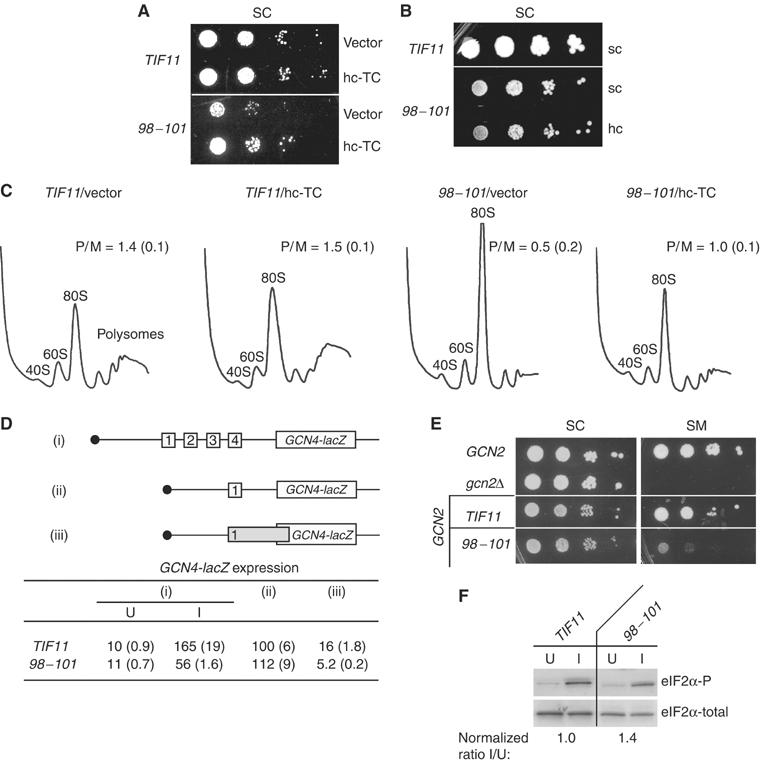
The 98–101 mutation confers a general initiation defect partially suppressed by hc-TC and also a Gcn− phenotype. (A) Serial dilutions of GCN2 strains H3583 and H3584 transformed with vector YEp24 or hc-TC plasmid p1780-IMT were spotted on SC-U and grown at 30°C for 2 days. (B) Serial dilutions of GCN2 strains containing sc WT TIF11-FL (H3583) or tif11-98–101-FL on an sc (H3584) or hc (H3585) plasmid were spotted on SC-L and grown at 30°C for 3 days. (C) Polysome profiles of the TIF11 and 98–101 transformants described in (A) were determined as described in Figure 2A. (D) The Gcn− phenotype of the 98–101 allele is not caused by impaired reinitiation or by leaky-scanning of uORF1. The GCN2 strains H3583 and H3584 harboring plasmids p180, pM199 or pM226, containing GCN4-lacZ reporters depicted schematically in (i), (ii) and (iii), respectively, were assayed for β-galactosidase activity after culturing in the absence (U) or presence (I) of 0.5 μg/ml SM for reporter (i), or in the absence of SM for reporters (ii) and (iii). Units of specific activity are means±s.e. (n=6). (E) The 98–101 mutation confers a Gcn− phenotype. GCN2 strains H3583 and H3584, together with H1642 harboring YCplac111 and H2999, were spotted on SC-L, and SC lacking Leu, Ile and Val (SC-LIV)+1 μg/ml SM, and grown at 30°C for 3–4 days. (F) The 98–101 mutation does not reduce eIF2α phosphorylation. The GCN2 strains H3583 and H3584 were grown to OD600≈1 in SC (U, uninducing) or SC-IV (I, inducing) medium and 0.5 μg/ml SM was added to the latter for 3 h at 30°C. WCEs were subjected to Western analysis using antibodies specific for eIF2α phosphorylated on Ser-51 (eIF2α-P; upper panel) and antibodies against total eIF2α lower panel), and the mean ratios of eIF2α-P/eIF2α were calculated and normalized to the WT ratio in each medium from two independent experiments.