



Summary
Background
Transarterial chemoembolisation (TACE) is standard of care for patients with unresectable hepatocellular carcinoma that is amenable to embolisation; however, median progression-free survival is still approximately 7 months. We aimed to assess whether adding durvalumab, with or without bevacizumab, might improve progression-free survival.
Methods
In this multiregional, randomised, double-blind, placebo-controlled, phase 3 study (EMERALD-1), adults aged 18 years or older with unresectable hepatocellular carcinoma amenable to embolisation, an Eastern Cooperative Oncology Group performance status of 0 or 1 at enrolment, and at least one measurable intrahepatic lesion per modified Response Evaluation Criteria in Solid Tumours (RECIST) were enrolled at 157 medical sites including research centres and general and specialist hospitals in 18 countries. Eligible patients were randomly assigned (1:1:1), stratified by TACE method, region, and portal vein invasion, using an interactive voice response or web response system, to TACE plus either durvalumab plus bevacizumab (1500 mg intravenous durvalumab once every 4 weeks, then 1120 mg durvalumab plus 15 mg/kg intravenous bevacizumab once every 3 weeks), durvalumab plus placebo (same regimen using placebo instead of bevacizumab), or placebo alone (same regimen using placebo instead of durvalumab and instead of bevacizumab). Participants, investigators, and those assessing outcomes were masked to treatment assignment until data analysis. The primary endpoint was progression-free survival, by blinded independent central review (BICR), and per RECIST version 1.1, with durvalumab plus bevacizumab versus placebo alone in the intention-to-treat population (ITT; ie, all participants assigned to treatment). Key secondary endpoints were progression-free survival by BICR per RECIST version 1.1 with durvalumab plus placebo versus placebo alone, overall survival, and time to deterioration in select patient-reported outcomes. Participants continue to be followed up for overall survival, and overall survival and patient-reported outcomes will be reported in a later publication. Safety was assessed in the safety analysis set, which included all participants assigned to treatment who received any study treatment (ie, any durvalumab, bevacizumab, or placebo) by treatment received. This study is registered with ClinicalTrials.gov, NCT03778957, and is closed to accrual.
Findings
Between Nov 30, 2018, and July 19, 2021, 887 patients were screened, of whom 616 were randomly assigned to durvalumab plus bevacizumab (n=204), durvalumab plus placebo (n=207), or placebo alone (n=205; ITT population). Median age was 65·0 years (IQR 59·0–72·0), 135 (22%) of 616 participants were female, 481 (78%) were male, 375 (61%) were Asian, 176 (29%) were White, 22 (4%) were American Indian or Alaska Native, nine (1%) were Black or African American, one (<1%) was native Hawaiian or other Pacific Islander, and 33 (5%) were other races. As of data cutoff (Sept 11, 2023) median follow-up for progression-free survival was 27·9 months (95% CI 27·4–30·4), median progression-free survival was 15·0 months (95% CI 11·1–18·9) with durvalumab plus bevacizumab, 10·0 months (9·0–12·7) with durvalumab, and 8·2 months (6·9–11·1) with placebo. Progression-free survival hazard ratio was 0·77 (95% CI 0·61–0·98; two-sided p=0·032) for durvalumab plus bevacizumab versus placebo, and 0·94 (0·75–1·19; two-sided p=0·64) for durvalumab plus placebo versus placebo. The most common maximum grade 3–4 adverse events were hypertension in participants who received durvalumab and bevacizumab (nine [6%] of 154 participants), anaemia in participants who received durvalumab and placebo (ten [4%] of 232 participants), and post-embolisation syndrome in participants who received placebo alone (eight [4%] of 200 participants). Study treatment-related adverse events that led to death occurred in none of 154 participants who received durvalumab and bevacizumab, three (1%) of 232 who received durvalumab and placebo (n=1 for arterial haemorrhage, liver injury, and multiple organ dysfunction syndrome), and three (2%) of 200 who received placebo alone (n=1 for oesophageal varices haemorrhage, upper gastrointestinal haemorrhage, and dermatomyositis).
Interpretation
Durvalumab plus bevacizumab plus TACE has the potential to set a new standard of care. With 1 additional follow-up of the EMERALD-1 study, future analyses, including the final overall survival data and patient-reported outcomes, will help to further characterise the potential clinical benefits of durvalumab plus bevacizumab plus TACE in hepatocellular carcinoma amenable to embolisation.
Funding
AstraZeneca.
Introduction
For patients with hepatocellular carcinoma who are not eligible for resection, ablation, or transplantation (ie, therapies with curative intent), transarterial chemoembolisation (TACE) is generally recommended for liver-confined disease with well defined nodules and preserved portal flow.1,2 TACE was established as standard of care for this population more than 20 years ago, after demonstrating improved overall survival over conservative management (ie, best supportive care);1–3 however, TACE guidelines vary regionally. In practice, the population of people receiving TACE globally is heterogeneous, including those with early-stage, intermediate-stage, and advanced-stage hepatocellular carcinoma and with varying tumour burden, liver function, and comorbidities.2,4–6
The aims of TACE include local tumour control, reducing tumour burden, and delaying disease progression.7–9 Although overall survival is a key endpoint in oncology trials, in unresectable hepatocellular carcinoma treated with TACE, long survival estimates, high subsequent systemic therapy use, and the competing risk of death from cirrhosis might confound overall survival results.10 Consequently, surrogate response-based or progression-based endpoints can be valuable and are being increasingly used in trials in this setting.4,8–12
For hepatocellular carcinoma treated with TACE, median progression-free survival remains poor, at approximately 7 months,10 and recurrence is common.13 In people without a response to TACE within the first two procedures, response rates to subsequent TACE are low14 and TACE procedures can lead to deterioration of liver function, limiting eligibility for systemic therapies after TACE.15 Combined with the risk of death due to cirrhosis, there is rationale to use systemic therapies earlier in the treatment pathway, in combination with TACE, to maximise clinical benefit.
Randomised phase 2 studies with sorafenib, a multikinase inhibitor, have demonstrated the potential benefit of adding systemic therapies to TACE. In one study, sorafenib plus drug-eluting bead (DEB)-TACE prolonged time to progression versus placebo plus DEB-TACE,9 and in another study, sorafenib plus TACE improved progression-free survival versus TACE alone.11 However, to date, no phase 3 study has shown significant clinical improvements in any primary endpoint by adding systemic therapy to TACE.7,8,12,16 Sorafenib did not significantly improve the primary endpoint of time to progression or the secondary endpoint of overall survival versus placebo in participants who responded to TACE,8 nor did it improve the primary endpoint of progression-free survival or the secondary endpoints of overall survival and time to progression in another study when combined with DEB-TACE.12
TACE increases vascular endothelial growth factor (VEGF) expression in hepatocellular carcinoma tumours, possibly allowing survival of residual tumour tissue after TACE. Combining antiangiogenic therapies with TACE might enhance antitumour activity by inhibiting tumour neovascularisation.17 In phase 3 studies, when combined with TACE, non-significant numerical improvements were observed for the secondary endpoints of time to extrahepatic spread or vascular invasion and time to progression with brivanib (a VEGF and fibroblast growth factor inhibitor),7 and time to progression with orantinib (a VEGF and platelet-derived growth factor receptor-β inhibitor);16 however, neither study found a significant improvement in overall survival, the primary endpoint.7,16 In a randomised pilot study, addition of bevacizumab (a VEGF inhibitor) to TACE showed promising progression-free survival;18 however, in a randomised phase 2 study, bevacizumab plus TACE did not improve time to progression or overall survival compared with TACE alone, and their concurrent administration resulted in safety concerns.19
TACE increases tumour PD-L1 expression, hence combination with anti-PD-1/PD-L1 immunotherapies might enhance antitumour activity.20 In advanced disease, anti-PD-1 and anti-PD-L1 monotherapies have shown clinical activity in terms of response21–23 with numerical improvements in overall survival that did not demonstrate superiority versus sorafenib (a previous standard of care for advanced hepatocellular carcinoma) in phase 3 studies.21,23 However, only combinations of anti-PD-1 and anti-PD-L1 and either anti-CTLA-4 or anti-VEGF therapies have shown significant improvements in overall survival in randomised phase 2 and 3 studies versus previous preferred regimens,1,21,24–26 with some combinations becoming new preferred regimens for advanced disease.2 These developments in treatment recommendations for advanced hepatocellular carcinoma, alongside the potential synergy theorised between TACE, immunotherapy, and anti-VEGF therapy,17,20 indicate the potential for immunotherapy-based combinations to improve outcomes for people with hepatocellular carcinoma amenable to TACE.
The phase 3 EMERALD-1 study was designed to assess the efficacy and safety of durvalumab (an anti-PD-L1 immunotherapy) with or without bevacizumab (an anti-VEGF therapy), in combination with TACE, in a global population of participants with unresectable hepatocellular carcinoma amenable to embolisation. Due to the aforementioned safety considerations,19 the study was designed to avoid concurrent bevacizumab and TACE (durvalumab was allowed with TACE, while bevacizumab was only started after completion of TACE). Here, we report results from the final progression-free survival (primary efficacy endpoint) analysis.
Methods
Study design and participants
EMERALD-1 is a multiregional, randomised, double-blind, placebo-controlled, phase 3 study, which enrolled participants at 157 medical centres (including treatment and research centres, and general and specialist hospitals) in 18 countries (appendix pp 34–37).
Eligible participants were aged 18 years or older with hepatocellular carcinoma (confirmed by imaging [multiphasic contrast-enhanced CT or MRI scans] or histopathology per local standards) not amenable to resection, ablation, or transplantation with curative intent, but amenable to TACE, with a tumour burden anticipated to be treatable with up to four TACE procedures within 16 weeks. Participants had to have no evidence of extrahepatic disease, a Child-Pugh score class A–B7 liver function, Eastern Cooperative Oncology Group (ECOG) performance status of 0 or 1 at enrolment, and at least one measurable intrahepatic lesion per modified Response Evaluation Criteria in Solid Tumours (mRECIST). An upper endoscopy was required within 6 months before random assignment to treatment to assess varices, risk of bleeding, and clinical fitness for starting bevacizumab, and to allow an opportunity to start prophylactic treatment. Exclusion criteria included previous systemic therapy for hepatocellular carcinoma, previous embolisation (embolisation as part of a regimen with curative intent [eg, in conjunction with ablation or surgery] was permitted), or major portal vein thrombosis (tumour thrombus in the first-order branches of the portal vein [Vp3] or tumour thrombus in one or both of the main trunk of the portal vein and a portal vein branch contralateral to the primarily involved lobe [Vp4]) on imaging. Full eligibility criteria are in the protocol (appendix pp 108–114).
Good Clinical Practice guidelines of the International Council on Harmonisation, and ethical considerations of the Declaration of Helsinki and Council for International Organisations of Medical Sciences, were followed. The trial protocol was approved by an Institutional Review Board or Independent Ethics Committee at each site (appendix pp 29–33). Written informed consent was obtained from participants (or their legal representatives if the participant lacked capacity to consent) before participation.
Randomisation and masking
Eligible participants were randomly assigned (1:1:1) to TACE in combination with either durvalumab plus bevacizumab, durvalumab plus placebo, or placebo alone. Randomisation was stratified by TACE modality (drug-eluting bead vs conventional), region (Japan vs the rest of Asia excluding Japan vs other regions), and portal vein invasion (Vp1 or Vp2 [±Vp1] vs none; where Vp1 indicates tumour thrombus distal to second-order branches of the portal vein and Vp2 indicates tumour thrombus within second-order branches of the portal vein). Participants were centrally assigned to their study treatment using an interactive voice or web response system (IxRS). At randomisation, the investigator or delegate obtained a unique randomisation number for eligible participants via the IxRS, and the participant was randomly assigned to one of the three treatment groups. The randomisation scheme was produced by a program incorporating a standard procedure for generating randomisation numbers. One randomisation list was produced for each of the randomisation strata. A blocked randomisation was generated; all centres used the same list to minimise imbalances in the number of participants assigned to each treatment group.
At each site, treatment was prepared by an unmasked pharmacist and masked using a translucent coloured or opaque sleeve, secured (eg, using stapling or heat-sealing) to maintain double-masked conditions. Participants, investigators, study centre staff, and those assessing outcomes were masked to treatment assignment until data analysis.
Procedures
Participants in the durvalumab plus bevacizumab group received TACE plus durvalumab (1500 mg intravenously, once every 4 weeks) followed by concurrent durvalumab (1120 mg once every 3 weeks) plus bevacizumab (15 mg/kg intravenously, once every 3 weeks). Participants in the durvalumab plus placebo group received TACE plus durvalumab (1500 mg once every 4 weeks) followed by concurrent durvalumab (1120 mg once every 3 weeks) plus placebo for bevacizumab (sterile saline intravenously, once every 3 weeks). Participants in the placebo alone group received TACE plus placebo for durvalumab (sterile saline or dextrose solution intravenously, once every 4 weeks) followed by concurrent placebo for durvalumab (once every 3 weeks) plus placebo for bevacizumab (once every 3 weeks; figure 1; appendix p 4).
Figure 1: Study schematic.

TACE=transarterial chemoembolisation. *1500 mg durvalumab, or placebo, once every 4 weeks. †1120 mg durvalumab, or placebo, once every 3 weeks. ‡15 mg/kg bevacizumab, or placebo, once every 3 weeks.
The number and timing of TACE procedures was at the investigator’s discretion, following local practice; however, the entire tumour burden had to be embolised and one to four TACE procedures were allowed and all had to be completed within the 16 weeks after the first TACE procedure. First dose of durvalumab or placebo was administered at least 7 days after the first TACE procedure (timing could be adjusted to accommodate for subsequent TACE). Concurrent durvalumab and bevacizumab (or their respective placebos) treatment started at least 14 days after the last TACE procedure.
Treatment continued until clinical or investigator-determined mRECIST-defined radiological disease progression, unacceptable toxicity, consent withdrawal, or other study-specific discontinuation criteria (eg, pregnancy or intent to become pregnant) were met. Participants could continue treatment after progression, including additional TACE, while remaining in the study if the investigator assessed that the participant was benefiting from treatment and met criteria for continuation (appendix pp 124–25). Details on the use of subsequent anticancer therapies after treatment discontinuation were collected; the type of subsequent anticancer therapies were not prespecified in the protocol. Dose reductions for durvalumab were not permitted. Dose modifications for bevacizumab were per local approved regulatory prescribing information or institutional guidelines. Participant sex and race data were either self-reported or obtained from electronic medical records.
Tumours were assessed by CT or MRI at baseline (≤28 days before randomisation), 12 weeks (±1 week) after randomisation, then every 9 weeks (±1 week) for the first 48 weeks after randomisation, and every 12 weeks (±1 week) thereafter until investigator-determined mRECIST-defined radiological progression. Disease progression was determined via blinded independent central review (BICR) per RECIST version 1.1, and by BICR and local investigators per mRECIST.
Adverse events were collected from the time written consent was provided until the follow-up period was completed (90 days after last dose of treatment). Adverse events were graded per the National Cancer Institute Common Terminology Criteria for Adverse Events, version 5. Whether adverse events were related to study treatment (ie, those possibly related to durvalumab, bevacizumab, or respective placebos) or provoked by TACE were assessed by the investigator. Due to the known risk of bleeding with bevacizumab, haemorrhagic adverse events are reported specifically. This is a key concern for TACE and people with liver cancer, who are at a higher risk of complications such as oesophageal varices. Additionally, people with compromised liver function are at a higher risk of bleeding. Details of follow-up for quality-of-life assessments are provided in the appendix (p 4). Participants will be followed up until the end of the study (at the overall survival final analysis).
Outcomes
The primary endpoint was progression-free survival (defined as time from randomisation to objective disease progression, per BICR and RECIST version 1.1, or death due to any cause in the absence of progression) with durvalumab plus bevacizumab versus placebo alone. The primary comparison was initially planned for durvalumab plus placebo versus placebo alone but was updated per a protocol amendment (protocol version 3.0; Aug 14, 2020) after the Independent Data Monitoring Committee reported no concerns with safety data, and in response to positive efficacy results observed with atezolizumab plus bevacizumab in advanced hepatocellular carcinoma.24
Key secondary endpoints were progression-free survival by BICR per RECIST version 1.1 with durvalumab plus placebo versus placebo alone, overall survival (defined as the time from randomisation until death due to any cause), and time to deterioration of European Organisation for Research and Treatment of Cancer (EORTC)-QLQ-C30 global health status and quality of life, functioning (physical), multiterm symptom (fatigue), single-item symptom (nausea), and EORTC QLQ-HCC18: single-item symptom (abdominal pain). Assessment of overall survival is ongoing and, to maintain masking, is not reported here. Patient-reported outcomes are not reported here because they have not yet been formally tested, per the multiple testing procedure.
Other secondary endpoints reported here are progression-free survival by BICR per RECIST version 1.1 at 12, 18, and 24 months; progression-free survival by BICR per mRECIST; time to progression (time from randomisation to objective disease progression by BICR per RECIST version 1.1); objective response rate (proportion of participants with confirmed complete or partial response), disease control rate, and duration of response by BICR per RECIST version 1.1; association between PD-L1 and α-fetoprotein expression levels with progression-free survival by BICR per RECIST version 1.1; and adverse events (further information on secondary endpoints is in the appendix [pp 277–80]). Unless otherwise stated, secondary endpoints were assessed for durvalumab plus bevacizumab versus placebo alone and for durvalumab plus placebo versus placebo alone.
Secondary endpoints not reported here are progression-free survival as assessed by the investigator per mRECIST; objective response rate, disease control rate, duration of response, and time to progression per investigator and BICR using mRECIST; the descriptive endpoint of progression-free survival by BICR per RECIST version 1.1 comparing the durvalumab plus bevacizumab group and the durvalumab plus placebo group; progression-free survival 2 (time from randomisation to progression after first subsequent therapy post first progression, or death) as assessed by the investigator per local standard clinical practice; overall survival at 12, 24, 36, 48, and 60 months; association of PD-L1 and α-fetoprotein expression levels with objective response rate, disease control rate, duration of response, and time to progression (assessed by BICR per RECIST version 1.1, by the investigator per mRECIST, and by BICR per mRECIST), and overall survival; other secondary endpoints related to patient-reported outcomes, including change from baseline and time to deterioration analysis of symptoms, functioning, and global health status and quality of life scale or item scores using the EORTC QLQ-C30 and EORTC QLQ-HCC18; the presence of anti-drug antibodies for durvalumab and bevacizumab; and the pharmacokinetics of durvalumab and bevacizumab in blood. These endpoints will be reported in subsequent publications.
Statistical analysis
We planned to randomly assign 600 participants (1:1:1) to the three treatment groups to achieve adequate statistical power for the study. Four formal analyses were planned: an interim and final analysis of progression-free survival and an interim and final analysis of overall survival. To provide strong control of the type 1 error rate at α=0·05 (two-sided), the primary progression-free survival objective (durvalumab plus bevacizumab versus placebo alone) was tested, to be followed by the secondary progression-free survival objective (durvalumab plus placebo versus placebo alone), overall survival, and patient-reported outcomes. The α expenditure was split between the interim and final analyses. The final progression-free survival analysis was planned for when approximately 287 events from approximately 400 participants had occurred across the durvalumab plus bevacizumab and placebo alone groups (72% maturity), providing more than 99% power to detect a statistically significant difference per the prespecified α allocation (appendix pp 4–5). At the final progression-free survival analysis, the threshold for significance of the primary objective was 0·044, based on the α spent at the progression-free survival interim analysis (2·27%) and the actual number of events at the final progression-free survival analysis
At the interim progression-free survival analysis (June 13, 2022), the primary endpoint had not met statistical significance. The final progression-free survival analysis (results reported here) and interim overall survival analysis co-occurred (date of data cutoff Sept 11, 2023). The interim overall survival analysis with durvalumab plus bevacizumab versus placebo alone did not meet statistical significance (data are not reported here in order to maintain masking); therefore, EMERALD-1 is ongoing for the final overall survival analysis, with investigators and participants remaining masked to assignments, and patient-reported outcomes have not been formally tested.
Efficacy endpoints were assessed in the intention-to-treat (ITT) population, comprising all participants randomly assigned to treatment, assessed by the treatment group they were assigned to, regardless of whether they received treatment or which treatment they received. Primary and secondary progression-free survival endpoints were analysed using a stratified log-rank test adjusting for TACE modality (drug-eluting bead vs conventional), region (Japan vs the rest of Asia excluding Japan vs other regions), and portal vein invasion (Vp1 or Vp2 [±Vp1] vs none). Treatment effects for progression-free survival and time to progression were estimated using a stratified Cox proportional hazards model, and medians and 95% CI were calculated using the Kaplan–Meier technique (not used for hypothesis testing; appendix pp 4–5). For progression-free survival, participants who had not progressed or died at the time of analysis were censored at the time of the latest date of assessment from their last evaluable RECIST assessment (the last visit with an evaluable overall response measurement). However, if the participant progressed or died immediately after two or more consecutive missed visits, the participant was censored at the time of the latest evaluable RECIST assessment before the two missed visits (a not evaluable visit was not considered to be a missed visit). For time to progression, censoring was defined as for progression-free survival except that if a participant died without progression, they were censored at their time of death.
For response outcomes, we excluded participants without measurable disease by BICR per RECIST version 1.1 at baseline. A visit with at least one missing tumour lesion measurement, where the response could not be assigned as progressive disease, was considered not evaluable.
Prespecified subgroup analyses of the primary endpoint of progression-free survival with durvalumab plus bevacizumab versus placebo alone, by stratification factors (TACE modality, region, and portal vein invasion) and participant demographic and disease characteristics (sex, age, aetiology of liver disease, ECOG performance status, baseline PD-L1 tumour area positivity, baseline α-fetoprotein expression, Child-Pugh score at randomisation, race, number of target lesions, baseline hepatoma arterial-embolisation prognostic score, baseline tumour burden, and baseline albumin-bilirubin grade), were done using an unstratified Cox proportional hazards model, with treatment as the only covariate. Hazard ratios (HRs) and 95% CIs were not calculated for subgroups if there were fewer than 20 events in the subgroup. Subgroup analysis by Barcelona Clinic Liver Cancer (BCLC) stage was done post hoc.
Missing values were not imputed and were assumed to be missing at random.
Safety data were summarised descriptively in the safety analysis set, comprising all participants randomly assigned to treatment who received any study treatment (ie, any durvalumab, bevacizumab, or placebo) by treatment received, regardless of group they were randomly assigned to (eg, participants who received durvalumab and TACE but no bevacizumab were grouped together, regardless of whether they were randomly assigned to the durvalumab plus bevacizumab group or the durvalumab plus placebo group). Prespecified exposure-adjusted adverse event rates per 100 person-years were calculated; defined as the number of participants with at least one adverse event divided by the total duration of follow-up across all participants in each treatment group in years multiplied by 100. Haemorrhagic adverse events in participants with baseline oesophageal varices were assessed post hoc.
Prespecified sensitivity analyses are reported for progression-free survival to assess whether missing or censored data introduced bias into the results. An evaluation-time bias analysis was performed using the midpoint between time of progression and the previous evaluable assessment to derive time to progression for participants with RECIST progression events. For participants whose death was treated as a progression-free survival event, the date of death was used. An attrition bias analysis was performed by counting progression, or death in the absence of progression, immediately following two or more non-evaluable tumour assessments as events instead of the participant being censored. An attrition bias analysis was also performed by censoring participants who had subsequent anticancer therapy before their last evaluable RECIST assessment or progression or death, at their last evaluable assessment.
SAS (version 9.1 or higher) was used for all analyses. An Independent Data Monitoring Committee reviewed safety data approximately every 6 months.
Role of the funding source
The funder had a role in the study design, data collection, data analysis, data interpretation, and writing of the report.
Results
Between Nov 30, 2018, and July 19, 2021, 887 patients with hepatocellular carcinoma were screened at 157 sites in 18 countries, of whom 616 were enrolled and randomly assigned to the durvalumab plus bevacizumab group (n=204), durvalumab plus placebo group (n=207), or the placebo alone group (n=205; ITT population), in combination with TACE (figure 2). Median age was 65·0 years (IQR 59·0–72·0), 135 (22%) of 616 participants were female, 481 (78%) were male, 375 (61%) were Asian, 176 (29%) were White, 22 (4%) were American Indian or Alaska Native, nine (1%) were Black or African American, one (<1%) was native Hawaiian or other Pacific Islander, and 33 (5%) were other races. Participant demographics and disease characteristics were generally balanced across the groups (table 1); however, there was a minor imbalance in the prognostic factor albumin-bilirubin, with 100 (48%) of 207 participants in the durvalumab plus placebo group and 79 (39%) of 205 participants in the placebo alone group having albumin-bilirubin grade 2 or higher. Most participants received one (186 [30%] of 616) or two (204 [33%]) TACE procedures (appendix p 9). Rates of important protocol deviations were low (appendix p 10). 50 (25%) of 204 participants in the durvalumab plus bevacizumab group, 62 (30%) of 207 in the durvalumab plus placebo group, and 43 (21%) of 205 in the placebo alone group had oesophageal varices at baseline (appendix p 11), of whom, 40 (80%) of 50 in the durvalumab plus bevacizumab group, 49 (79%) of 62 in the durvalumab plus placebo group, and 35 (81%) of 43 in the placebo alone group received bevacizumab or placebo for bevacizumab. As of data cutoff (Sept 11, 2023), median duration of follow-up for progression-free survival was 27·9 months (95% CI 27·4–30·4).
Figure 2: Trial profile.
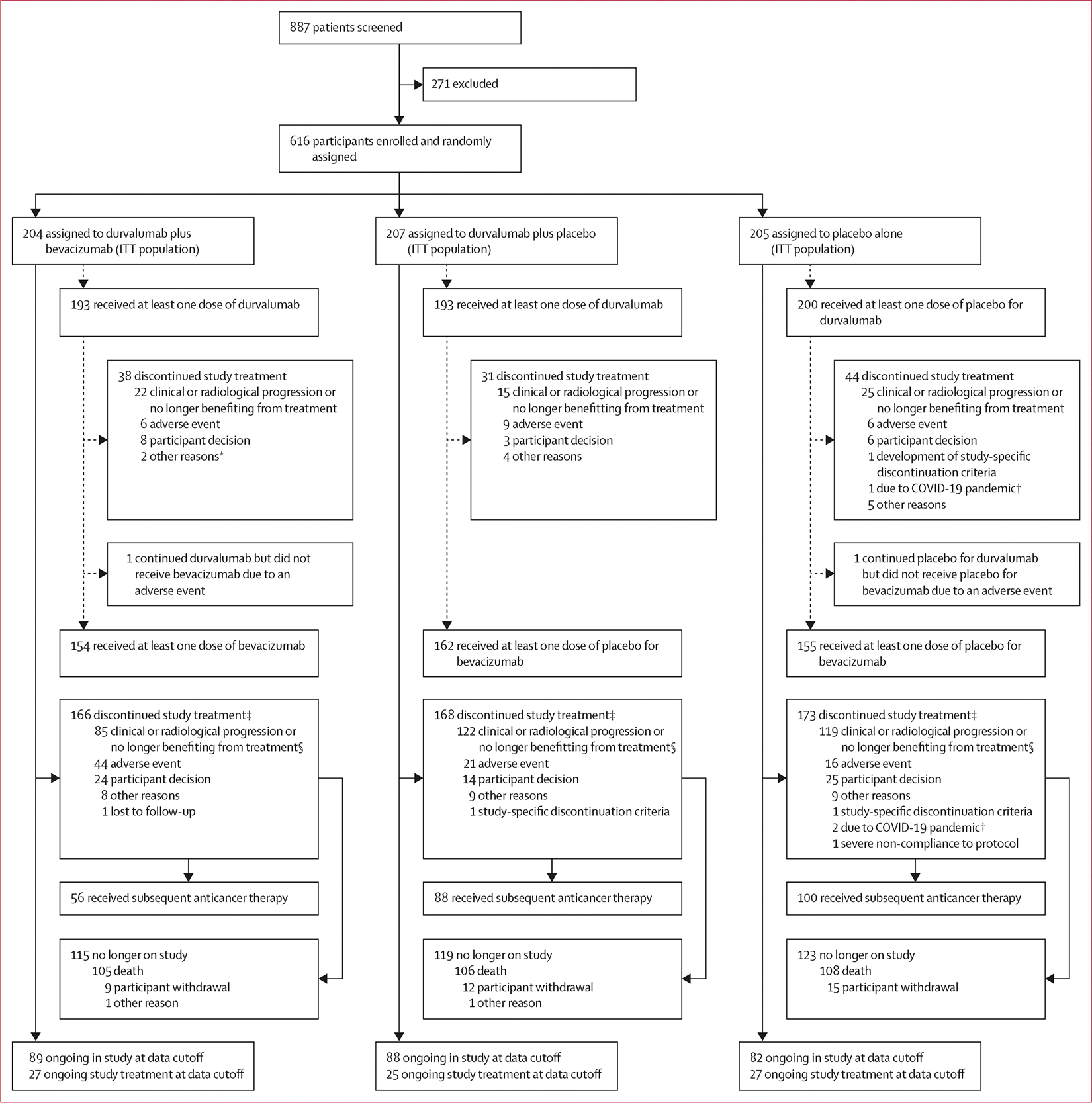
Categories for participants who discontinued study treatment, are no longer ongoing in study, or who received subsequent anticancer therapy are not exclusive, and participants might be included in more than one of these categories. ITT=intention-to-treat. *One participant discontinued study treatment because their second lesion did not respond to TACE and one participant discontinued study treatment due to deteriorating performance status. †One participant discontinued study treatment due to COVID-19 pandemic-related logistics and one participant discontinued study treatment before receiving placebo for bevacizumab due to clinical judgement after COVID-19 infection resolution. ‡Reasons for discontinuation of study treatment only include reasons for durvalumab discontinuation. §As assessed by the investigator.
Table 1:
Baseline demographic and clinical characteristics, intention-to-treat population
| Durvalumab plus bevacizumab group (n=204) | Durvalumab plus placebo group (n=207) | Placebo alone group (n=205) | |
|---|---|---|---|
|
| |||
| Age, years | 64·5 (58·0–73·0) | 65·0 (59·0–72·0) | 66·0 (59·0–71·0) |
| Sex* | |||
| Male | 162 (79%) | 156 (75%) | 163 (80%) |
| Female | 42 (21%) | 51 (25%) | 42 (20%) |
| Geographical region | |||
| Japan | 15 (7%) | 15 (7%) | 15 (7%) |
| Asia (not including Japan) | 107 (52%) | 108 (52%) | 107 (52%) |
| Other regions | 82 (40%) | 84 (41%) | 83 (40%) |
| Race* | |||
| Asian | 126 (62%) | 124 (60%) | 125 (61%) |
| White | 55 (27%) | 62 (30%) | 59 (29%) |
| American Indian or Alaska Native | 12 (6%) | 5 (2%) | 5 (2%) |
| Black or African American | 3 (1%) | 3 (1%) | 3 (1%) |
| Native Hawaiian or other Pacific Islander | 0 | 1 (<1%) | 0 |
| Other race | 8 (4%) | 12 (6%) | 13 (6%) |
| Aetiology of liver disease | |||
| Hepatitis B virus | 75 (37%) | 70 (34%) | 74 (36%) |
| Hepatitis C virus | 42 (21%) | 48 (23%) | 54 (26%) |
| Non-viral | 86 (42%) | 88 (43%) | 76 (37%) |
| Both | 1 (<1%) | 1 (<1%) | 1 (<1%) |
| ECOG performance status | |||
| 0 | 167 (82%) | 173 (84%) | 175 (85%) |
| 1 | 37 (18%) | 34 (16%) | 30 (15%) |
| Child-Pugh score | |||
| Class A | 200 (98%) | 201 (97%) | 201 (98%) |
| Class B | 4 (2%) | 6 (3%) | 4 (2%) |
| Albumin-bilirubin grade | |||
| 1 | 117 (57%) | 107 (52%) | 126 (61%) |
| ≥2 | 87 (43%) | 100 (48%) | 79 (39%) |
| Barcelona Clinic Liver Cancer stage | |||
| A | 51 (25%) | 59 (29%) | 49 (24%) |
| B | 117 (57%) | 114 (55%) | 122 (60%) |
| C | 35 (17%) | 33 (16%) | 31 (15%) |
| Missing | 1 (<1%) | 1 (<1%) | 3 (1%) |
| Tumour burden† | |||
| Within up-to-7 criteria (≤7) | 97 (48%) | 97 (47%) | 102 (50%) |
| Beyond up-to-7 criteria (>7) | 106 (52%) | 110 (53%) | 103 (50%) |
| Missing | 1 (<1%) | 0 | 0 |
| Portal vein macrovascular invasion | |||
| No | 188 (92%) | 194 (94%) | 192 (94%) |
| Yes | 16 (8%) | 13 (6%) | 13 (6%) |
| Hepatoma arterial-embolisation prognostic score‡ | |||
| A | 66 (32%) | 63 (30%) | 64 (31%) |
| B | 74 (36%) | 72 (35%) | 75 (37%) |
| C | 41 (20%) | 52 (25%) | 48 (23%) |
| D | 20 (10%) | 20 (10%) | 18 (9%) |
| Missing | 3 (1%) | 0 | 0 |
| PD-L1 tumour area positivity | |||
| High (≥1%) | 61 (30%) | 63 (30%) | 64 (31%) |
| Low (<1%) | 93 (46%) | 97 (47%) | 88 (43%) |
| Missing | 50 (25%) | 47 (23%) | 53 (26%) |
| Histology type | |||
| Hepatocellular carcinoma | 174 (85%) | 179 (86%) | 173 (84%) |
| Other§ | 29 (14%) | 28 (14%) | 31 (15%) |
| Missing | 1 (<1%) | 0 | 1 (<1%) |
Data are median (IQR) or n (%). Disease characteristics are at screening or initial diagnosis. Percentages might not total to 100% due to rounding to whole numbers. ECOG=Eastern Cooperative Oncology Group.
Participants’ sex and race were either self-reported or obtained from medical records during trial screening; options were those listed in the table; participant gender was not recorded.
Within up-to-7 criteria: sum of size (in cm) and number of tumours of seven or less; beyond up-to-seven criteria: sum of size (in cm) and number of tumours greater than seven.
Hepatoma arterial-embolisation prognostic scores are defined as A, 0; B, 1; C, 2; and D, >2 of the following criteria: albumin <36 g/L, α-fetoprotein >400 ng/mL, bilirubin >17 μmol/L, and maximum tumour diameter >7 cm.
Includes participants whose hepatocellular carcinoma diagnosis was done via imaging.
Median duration of follow-up for progression-free survival in all participants was 27·8 months (95% CI 24·9–30·9) in the durvalumab plus bevacizumab group, 30·3 months (22·2–33·0) in the durvalumab plus placebo group, and 27·5 months (25·0–33·2) in the placebo alone group. As of data cutoff, progression-free survival events occurred in 136 (67%) of 204 participants (99 progressions and 37 deaths) in the durvalumab plus bevacizumab group, 144 (70%) of 207 (120 progressions and 24 deaths) in the durvalumab plus placebo group, and 149 (73%) of 205 (132 progressions and 17 deaths) in the placebo alone group.
The primary efficacy endpoint was met; durvalumab plus bevacizumab significantly improved progression-free survival by BICR per RECIST version 1.1 versus placebo (median 15·0 months [95% CI 11·1–18·9] vs 8·2 months [6·9–11·1]; HR 0·77 [95% CI 0·61–0·98]; two-sided log-rank p=0·032; figure 3A). Durvalumab plus placebo alone did not significantly improve progression-free survival versus placebo (median 10·0 months [95% CI 9·0–12·7] vs 8·2 months [6·9–11·1]; HR 0·94 [95% CI 0·75–1·19]; two-sided log-rank p=0·64; figure 3B). Evaluation-time bias and attrition bias sensitivity analyses showed generally consistent results (appendix p 12). As of data cutoff, 45 (22%) of 204 participants in the durvalumab plus bevacizumab group, 40 (19%) of 207 participants in the durvalumab plus placebo group, and 33 (16%) of 205 participants in the placebo alone group were censored and remained progression free. The progression-free survival benefit with durvalumab plus bevacizumab was generally consistent across key subgroups, including by PD-L1 and α-fetoprotein expression levels (figure 4).
Figure 3: Progression-free survival, assessed by BICR per RECIST version 1.1, in the durvalumab plus bevacizumab group versus the placebo alone group (primary endpoint; A) and in the durvalumab plus placebo group versus the placebo alone group (key secondary endpoint; B), in the intention-to-treat population.

BICR=blinded independent central review. RECIST=Response Evaluation Criteria in Solid Tumours. *Threshold of significance for this analysis was 0·044, based on the α spent at the progression-free survival interim analysis (2·27%) and the actual number of events at the final progression-free survival analysis.
Figure 4: Subgroup analysis of progression-free survival, assessed by BICR per RECIST version 1.1, in the durvalumab plus bevacizumab group versus the placebo alone group in the intention-to-treat population.

Size of circles are proportional to the number of events. Participant subgroups for region, transarterial chemoembolisation technique, and portal vein invasion are per values entered into the interactive voice response system at randomisation. For subgroups with fewer than 20 events, hazard ratios were not calculated. BICR=blinded independent central review. ECOG=Eastern Cooperative Oncology Group. NC=not calculated. RECIST=Response Evaluation Criteria in Solid Tumours. ULN=upper limit of normal. *One participant in each group had both hepatitis B virus and hepatitis C virus; neither of these participants had a progression-free survival event. †PD-L1 tumour area positivity data were missing for 50 participants in the durvalumab plus bevacizumab group and 53 participants in the placebo alone group; the hazard ratio in the missing subgroup was 0·66 (95% CI 0·39–1·11). ‡α-fetoprotein data were missing for one participant in the durvalumab plus bevacizumab group; this participant had an event; the normal range for α-fetoprotein per local laboratory ranges was 0–25 IU/mL. §Number of target lesions at baseline data were missing for one participant in the durvalumab plus bevacizumab group; this participant did not have an event. ¶Hepatoma arterial-embolisation prognostic score was missing for three participants in the durvalumab plus bevacizumab group. ‖Baseline tumour burden data were missing for one participant in the durvalumab plus bevacizumab group. **Post-hoc subgroup analysis.
Progression-free survival results by BICR per mRECIST were consistent with those per RECIST version 1.1, with a median progression-free survival of 14·2 months (95% CI 11·1–17·4) in the durvalumab plus bevacizumab group, 9·0 months (7·0–10·9) in the durvalumab plus placebo group, and 8·2 months (6·9–9·5) in the placebo alone group (durvalumab plus bevacizumab vs placebo alone: HR 0·75 [95% CI 0·60–0·95]; durvalumab plus placebo vs placebo alone: 0·99 [0·79–1·25]; appendix p 6).
Overall, 99 (49%) of 204 participants in the durvalumab plus bevacizumab group, 120 (58%) of 207 participants in the durvalumab plus placebo group, and 132 (64%) of 205 participants in the placebo alone group had disease progression by BICR per RECIST version 1.1. Median time to progression was 22·0 months (95% CI 16·6–24·9) in the durvalumab plus bevacizumab group, 11·5 months (95% CI 9·2–13·9) in the durvalumab plus placebo group, and 10·0 months (7·1–13·6) in the placebo alone group (durvalumab plus bevacizumab vs placebo alone: HR 0·63 [95% CI 0·48–0·82]; durvalumab plus placebo vs placebo alone: 0·89 [0·69–1·15]; appendix p 7).
Among participants with measurable disease at baseline, objective response rates by BICR per RECIST version 1.1 were 44% (88 of 202 partic i pants) with durvalumab plus bevacizumab, 41% (84 of 205 participants) with durvalumab, and 30% (60 of 203 participants) with placebo (appendix p 13). Median duration of response was 22·1 months (IQR 11·2–30·3) in the durvalumab plus bevacizumab group, 14·0 months (6·9–30·7) in the durvalumab plus placebo group, and 16·4 months (6·3–26·3) in the placebo alone group. Other response outcomes by BICR per RECIST version 1.1 are shown in the appendix (p 13).
The number of participants who received subsequent anticancer therapies with curative intent was similar across groups (appendix p 14). EMERALD-1 continues for the final overall survival analysis, at which stage, additional analyses on subsequent anticancer therapies will be provided.
The safety analysis set comprised 154 participants who received durvalumab, bevacizumab, and TACE, 232 participants who received durvalumab, placebo, and TACE (including 193 [93%] of 207 participants assigned to the durvalumab plus placebo group and 39 [19%] of 204 participants assigned to the durvalumab plus bevacizumab group), and 200 participants who received placebo and TACE, regardless of randomly assigned treatment group (figure 2).
Across the total study, median duration of exposure to durvalumab was 13·8 months (IQR 7·5–24·3) in participants who received durvalumab and bevacizumab and 7·2 months (2·8–15·6) in participants who received durvalumab and placebo, and median duration of exposure to placebo was 8·7 months (4·6–18·4) in participants who received placebo (appendix p 15). During the TACE period, median duration of exposure to durvalumab or placebo was 2·8 months (1·8–3·7) in each treatment group. During the post-TACE period, median duration of exposure to bevacizumab or placebo was 9·4 months (3·7–19·4) in the durvalumab and bevacizumab group, 6·9 months (3·5–16·0) in the durvalumab and placebo group, and 8·3 months (4·1–20·9) in the placebo group (appendix p 15).
Adverse events of any grade and cause occurred in 151 (98%) of 154 participants who received durvalumab and bevacizumab, 215 (93%) of 232 participants who received durvalumab and placebo, and 186 (93%) of 200 participants who received placebo (table 2); the exposure-adjusted event rates per 100 person-years were 67·6, 94·8, and 81·8, respectively (appendix p 16). Study treatment-related adverse events of any grade occurred in 124 (81%) of 154 participants who received durvalumab and bevacizumab, 117 (50%) of 232 participants who received durvalumab and placebo, and 90 (45%) of 200 participants who received placebo (table 2); the exposure-adjusted event rates per 100 person-years were 55·5, 51·6, and 39·6, respectively (appendix p 16).
Table 2:
Adverse event summary, safety analysis set
| Participants who received durvalumab, bevacizumab, and TACE (n=154) | Participants who received durvalumab, placebo, and TACE (n=232) | Participants who only received placebo and TACE (n=200) | |
|---|---|---|---|
|
| |||
| Any adverse event | 151 (98%) | 215 (93%) | 186 (93%) |
| Study treatment-related | 124 (81%) | 117 (50%) | 90 (45%) |
| Possibly related to durvalumab or placebo | 108 (70%) | 114 (49%) | 79 (40%) |
| Possibly related to bevacizumab or placebo | 91 (59%) | 40 (17%) | 50 (25%) |
| Provoked by TACE | 78 (51%) | 101 (44%) | 95 (48%) |
| Serious adverse events (including adverse events with outcome of death) | 74 (48%) | 84 (36%) | 62 (31%) |
| Study treatment-related | 30 (19%) | 13 (6%) | 10 (5%) |
| Possibly related to durvalumab or placebo | 21 (14%) | 9 (4%) | 7 (4%) |
| Possibly related to bevacizumab or placebo | 18 (12%) | 5 (2%) | 5 (3%) |
| Provoked by TACE | 12 (8%) | 21 (9%) | 19 (10%) |
| Any adverse event of maximum grade 3–4 | 70 (45%) | 64 (28%) | 46 (23%) |
| Any study treatment-related adverse event of maximum grade 3–4 | 41 (27%) | 15 (6%) | 12 (6%) |
| Any adverse event possibly related to durvalumab or placebo of maximum grade 3–4 | 24 (16%) | 12 (5%) | 10 (5%) |
| Any adverse event possibly related to bevacizumab or placebo of maximum grade 3–4 | 29 (19%) | 7 (3%) | 8 (4%) |
| Any adverse event provoked by TACE of maximum grade 3–4 | 13 (8%) | 21 (9%) | 17 (9%) |
| Any adverse event with outcome of death* | 16 (10%) | 21 (9%) | 11 (6%) |
| Study treatment-related | 0 | 3 (1%) | 3 (2%) |
| Possibly related to durvalumab or placebo | 0 | 2 (1%) | 1 (1%) |
| Possibly related to bevacizumab or placebo | 0 | 1 (<1%) | 2 (1%) |
| Provoked by TACE | 0 | 0 | 1 (1%) |
| Any adverse event leading to discontinuation | 43 (28%) | 30 (13%) | 15 (8%) |
| Study treatment-related | 19 (12%) | 8 (3%) | 6 (3%) |
| Possibly related to durvalumab or placebo | 11 (7%) | 6 (3%) | 3 (2%) |
| Possibly related to bevacizumab or placebo | 13 (8%) | 3 (1%) | 4 (2%) |
| Provoked by TACE | 0 | 2 (1%) | 2 (1%) |
| Leading to discontinuation of durvalumab or placebo | 37 (24%) | 26 (11%) | 14 (7%) |
| Leading to discontinuation of bevacizumab or placebo | 43 (28%) | 16 (7%) | 10 (5%) |
| Leading to discontinuation of bevacizumab or placebo but participant continued durvalumab | 6 (4%) | 3 (1%) | 1 (1%) |
| Immune-mediated adverse events | 52 (34%) | 49 (21%) | 20 (10%) |
| Infusion-reaction adverse events | 11 (7%) | 12 (5%) | 6 (3%) |
Data are n (%). TACE=transarterial chemoembolisation.
Deaths related to progressive disease are not included.
Overall, 16 (10%) of 154 participants who received durvalumab and bevacizumab, 21 (9%) of 232 participants who received durvalumab and placebo, and 11 (6%) of 200 participants who received placebo had adverse events leading to death (tables 2, 3; appendix pp 17–22). Study treatment-related adverse events leading to death, as assessed by the investigator, occurred in none of 154 participants who received durvalumab and bevacizumab, three (1%) of 232 participants who received durvalumab and placebo (n=1 for arterial haemorrhage, liver injury, and multiple organ dysfunction syndrome), and three (2%) of 200 participants who received placebo (n=1 for oesophageal varices haemorrhage, upper gastrointestinal haemorrhage, and dermatomyositis; table 2). In the ITT population deaths before receipt of study treatment occurred in seven (3%) of 204 participants assigned to the durvalumab plus bevacizumab group (n=3 due to disease under investigation only, n=2 adverse events with outcome of death only [sepsis and acute myocardial infarction], n=1 due to disease under investigation and an adverse event with death as outcome [hepatic function abnormal], and n=1 unknown cause), six (3%) of 207 participants assigned to the durvalumab plus placebo group (n=4 due to disease under investigation only, n=2 due to adverse event with outcome of death only [septic shock and acute kidney injury]), and two (1%) of 205 participants assigned to the placebo alone group (n=2 due to disease under investigation).
Table 3:
Adverse events, by maximum grade, safety analysis set
| Participants who received durvalumab, bevacizumab, and TACE (n=154) | Participants who received durvalumab, placebo, and TACE (n=232) | Participants who only received placebo and TACE (n=200) | ||||||||||
|---|---|---|---|---|---|---|---|---|---|---|---|---|
|
|
|
|
||||||||||
| Grade 1–2 | Grade 3 | Grade 4 | Grade 5 | Grade 1–2 | Grade 3 | Grade 4 | Grade 5 | Grade 1–2 | Grade 3 | Grade 4 | Grade 5 | |
|
| ||||||||||||
| Any adverse event | 65 (42%) | 61 (40%) | 9 (6%) | 16 (10%) | 130 (56%) | 62 (27%) | 2 (1%) | 21 (9%) | 129 (65%) | 41 (21%) | 5 (3%) | 11 (6%) |
| Post-embolisation syndrome | 36 (23%) | 5 (3%) | 0 | 0 | 42 (18%) | 8 (3%) | 0 | 0 | 47 (24%) | 8 (4%) | 0 | 0 |
| Hypothyroidism | 35 (23%) | 0 | 0 | 0 | 49 (21%) | 0 | 0 | 0 | 22 (11%) | 0 | 0 | 0 |
| Pruritus | 33 (21%) | 0 | 0 | 0 | 35 (15%) | 0 | 0 | 0 | 22 (11%) | 0 | 0 | 0 |
| Hypertension | 33 (21%) | 9 (6%) | 0 | 0 | 13 (6%) | 5 (2%) | 0 | 0 | 20 (10%) | 1 (1%) | 0 | 0 |
| Constipation | 29 (19%) | 0 | 0 | 0 | 29 (13%) | 0 | 0 | 0 | 22 (11%) | 0 | 0 | 0 |
| Proteinuria | 27 (18%) | 6 (4%) | 0 | 0 | 4 (2%) | 0 | 0 | 0 | 5 (3%) | 0 | 0 | 0 |
| Abdominal pain | 26 (17%) | 2 (1%) | 0 | 0 | 31 (13%) | 1 (<1%) | 0 | 0 | 27 (14%) | 0 | 0 | 0 |
| Diarrhoea | 25 (16%) | 2 (1%) | 0 | 0 | 32 (14%) | 0 | 0 | 0 | 37 (19%) | 0 | 0 | 0 |
| Decreased appetite | 23 (15%) | 0 | 0 | 0 | 22 (9%) | 1 (<1%) | 0 | 0 | 23 (12%) | 1 (1%) | 0 | 0 |
| Abdominal pain upper | 22 (14%) | 0 | 0 | 0 | 17 (7%) | 1 (<1%) | 0 | 0 | 18 (9%) | 0 | 0 | 0 |
| Arthralgia | 22 (14%) | 0 | 0 | 0 | 20 (9%) | 1 (<1%) | 0 | 0 | 21 (11%) | 0 | 0 | 0 |
| Pyrexia | 22 (14%) | 2 (1%) | 0 | 0 | 17 (7%) | 0 | 0 | 0 | 22 (11%) | 0 | 0 | 0 |
| COVID-19 | 20 (13%) | 0 | 0 | 4 (3%) | 19 (8%) | 1 (<1%) | 0 | 1 (<1%) | 22 (11%) | 0 | 0 | 1 (1%) |
| Oedema peripheral | 20 (13%) | 1 (1%) | 0 | 0 | 16 (7%) | 3 (1%) | 0 | 0 | 5 (3%) | 0 | 0 | 0 |
| Ascites | 20 (13%) | 4 (3%) | 0 | 0 | 7 (3%) | 4 (2%) | 0 | 0 | 4 (2%) | 3 (2%) | 0 | 0 |
| Rash | 19 (12%) | 1 (1%) | 0 | 0 | 23 (10%) | 0 | 0 | 0 | 8 (4%) | 0 | 0 | 0 |
| Fatigue | 16 (10%) | 3 (2%) | 0 | 0 | 24 (10%) | 1 (<1%) | 0 | 0 | 20 (10%) | 1 (1%) | 0 | 0 |
| Nausea | 16 (10%) | 0 | 0 | 0 | 20 (9%) | 0 | 0 | 0 | 15 (8%) | 0 | 0 | 0 |
| Insomnia | 16 (10%) | 0 | 0 | 0 | 15 (6%) | 0 | 0 | 0 | 17 (9%) | 0 | 0 | 0 |
| Anaemia | 14 (9%) | 7 (5%) | 0 | 0 | 15 (6%) | 10 (4%) | 0 | 0 | 16 (8%) | 3 (2%) | 0 | 0 |
| Urinary tract infection | 13 (8%) | 1 (1%) | 0 | 0 | 14 (6%) | 2 (1%) | 0 | 0 | 13 (7%) | 3 (2%) | 0 | 0 |
| Hepatic encephalopathy | 7 (5%) | 4 (3%) | 1 (1%) | 0 | 1 (<1%) | 1 (<1%) | 0 | 0 | 3 (2%) | 2 (1%) | 1 (1%) | 0 |
| Decreased platelet count | 5 (3%) | 3 (2%) | 0 | 0 | 5 (2%) | 0 | 0 | 0 | 2 (1%) | 1 (1%) | 0 | 0 |
| Hyperglycaemia | 5 (3%) | 2 (1%) | 0 | 0 | 6 (3%) | 0 | 0 | 0 | 2 (1%) | 0 | 0 | 0 |
| Thrombocytopenia | 4 (3%) | 2 (1%) | 1 (1%) | 0 | 4 (2%) | 1 (<1%) | 0 | 0 | 2 (1%) | 0 | 0 | 0 |
| Hepatic cirrhosis | 4 (3%) | 2 (1%) | 0 | 0 | 1 (<1%) | 0 | 0 | 1 (<1%) | 0 | 0 | 0 | 0 |
| Colitis | 3 (2%) | 3 (2%) | 0 | 0 | 1 (<1%) | 0 | 0 | 0 | 0 | 0 | 0 | 0 |
| Spontaneous bacterial peritonitis | 3 (2%) | 2 (1%) | 0 | 0 | 0 | 0 | 0 | 0 | 0 | 0 | 0 | 0 |
| Gastrointestinal haemorrhage | 3 (2%) | 2 (1%) | 0 | 0 | 1 (<1%) | 0 | 0 | 1 (<1%) | 1 (1%) | 0 | 0 | 0 |
| Pneumonia | 2 (1%) | 2 (1%) | 1 (1%) | 0 | 5 (2%) | 1 (<1%) | 0 | 2 (1%) | 2 (1%) | 0 | 0 | 0 |
| Hyperbilirubinaemia | 2 (1%) | 2 (1%) | 0 | 0 | 2 (1%) | 0 | 0 | 0 | 0 | 0 | 0 | 0 |
| Renal failure | 2 (1%) | 2 (1%) | 0 | 0 | 0 | 0 | 0 | 0 | 2 (1%) | 0 | 0 | 0 |
| Increased alanine aminotransferase | 2 (1%) | 2 (1%) | 0 | 0 | 2 (1%) | 1 (<1%) | 0 | 0 | 4 (2%) | 2 (1%) | 0 | 0 |
| Acute kidney injury | 1 (1%) | 6 (4%) | 0 | 1 (1%) | 2 (1%) | 3 (1%) | 1 (<1%) | 0 | 1 (1%) | 0 | 0 | 1 (1%) |
| Oesophageal varices haemorrhage | 1 (1%) | 4 (3%) | 0 | 0 | 0 | 0 | 0 | 1 (<1%) | 0 | 1 (1%) | 0 | 1 (1%) |
| Hypoglycaemia | 1 (1%) | 2 (1%) | 0 | 0 | 1 (<1%) | 0 | 0 | 1 (<1%) | 2 (1%) | 0 | 0 | 0 |
| Gastric ulcer haemorrhage | 0 | 2 (1%) | 0 | 0 | 1 (<1%) | 0 | 0 | 0 | 0 | 0 | 0 | 0 |
| Hyponatraemia | 0 | 1 (1%) | 3 (2%) | 0 | 5 (2%) | 1 (<1%) | 0 | 0 | 0 | 0 | 0 | 0 |
| Sepsis | 0 | 0 | 0 | 3 (2%) | 0 | 2 (1%) | 0 | 1 (<1%) | 2 (1%) | 0 | 0 | 1 (1%) |
| Death due to unknown cause | 0 | 0 | 0 | 3 (2%) | 0 | 0 | 0 | 3 (1%) | 0 | 0 | 0 | 1 (1%) |
| Cholecystitis | 0 | 0 | 0 | 0 | 1 (<1%) | 3 (1%) | 0 | 0 | 1 (1%) | 0 | 0 | 0 |
| Anaphylactic reaction | 0 | 0 | 0 | 0 | 1 (<1%) | 0 | 0 | 0 | 0 | 0 | 2 (1%) | 0 |
| Prostate cancer | 0 | 0 | 0 | 0 | 0 | 0 | 0 | 0 | 1 (1%) | 2 (1%) | 0 | 0 |
| Femur fracture | 0 | 0 | 0 | 0 | 0 | 0 | 0 | 0 | 0 | 2 (1%) | 0 | 0 |
Data are shown for maximum grade 1–2 adverse events that occurred in at least 10% of participants, and maximum grade 3, 4, or 5 adverse events that occurred in at least 1% of participants. Data are n (%). TACE=transarterial chemoembolisation.
The most common grade maximum 3–4 adverse events were hypertension (nine [6%] of 154), anaemia (seven [5%]), acute kidney injury (six [4%]), and proteinuria (six [4%]) among those who received durvalumab and bevacizumab; anaemia (ten [4%] of 232), post-embolisation syndrome (eight [3%]), and hypertension (five [2%]) among those who received durvalumab and placebo; and post-embolisation syndrome (eight [4%] of 200), anaemia (three [2%]), hepatic encephalopathy (three [2%]), ascites (three [2%]), and urinary tract infection (three [2%]) among those who received placebo (table 3; appendix p 23). Adverse events that occurred in more than 5% of participants in any treatment group are shown in the appendix (p 24). Hypertension was the most common adverse event of any grade in participants who received durvalumab and bevacizumab (42 [27%] of 154 participants; hypertension occurred in 18 [8%] of 232 who received durvalumab and placebo, and 21 (11%) of 200 who received placebo). Post-embolisation syndrome was the most common adverse event of any grade in participants who received durvalumab and placebo (50 [22%] participants) or placebo (55 [28%] participants) and was the second most common adverse event of any grade in participants who received durvalumab and bevacizumab (41 [27%] participants). Hypothyroidism was observed in 35 (23%) participants who received durvalumab and bevacizumab, 49 (21%) participants who received durvalumab and placebo, and 22 (11%) participants who received placebo. Adverse events that led to discontinuation of study treatment are shown in the appendix (pp 25–26).
Haemorrhagic events occurred in 43 (28%) of 154 participants who received durvalumab and bevacizumab, 24 (10%) of 232 participants who received durvalumab and placebo, and 27 (14%) of 200 participants who received placebo (appendix p 27). Fatal haemorrhagic events occurred in no participants who received durvalumab and bevacizumab, in six (3%) who received durvalumab and placebo, and two (1%) who received placebo. Maximum grade 3–4 haemorrhagic events occurred in 14 (9%) participants who received durvalumab and bevacizumab, none who received durvalumab and placebo, and two (1%) who received placebo. Among participants with baseline oesophageal varices, fatal oesophageal varices haemorrhage occurred after bevacizumab dosing (or placebo for bevacizumab dosing) in no participants who received durvalumab and bevacizumab, no participants who received durvalumab and placebo, and one (2%) participant who received placebo. Among participants with baseline oesophageal varices, maximum grade 3–4 oesophageal varices haemorrhage occurred after bevacizumab dosing (or after placebo for bevacizumab dosing) in four (10%) participants who received durvalumab and bevacizumab, no participants who received durvalumab and placebo, and no participants who received placebo (appendix p 28).
Discussion
EMERALD-1 reported positive results for its primary efficacy endpoint, with a significant improvement in progression-free survival observed with durvalumab plus bevacizumab plus TACE versus placebo plus TACE in participants with unresectable hepatocellular carcinoma. Median progression-free survival was improved by 6·8 months versus the placebo plus TACE group, which had results that were consistent with previous reports.10 The consistent improvements with durvalumab plus bevacizumab versus placebo alone across progression-free survival, time to progression, and objective response rate are clinically relevant in this setting, where treatment goals include controlling tumour growth, reducing tumour burden, and delaying progression. To our knowledge, this evaluation of the combination of immunotherapy, anti-VEGF therapy, and TACE is the first phase 3 trial to report a positive primary endpoint in this setting. During the preparation of this Article, the phase 3 LEAP-012 study also showed a significant progression-free survival benefit with anti-PD-1 immunotherapy (pembrolizumab) plus a multikinase inhibitor with anti-VEGF activity (lenvatinib) plus TACE versus TACE alone in people with unresectable, non-metastatic hepatocellular carcinoma (HR 0·66 [95% CI 0·51–0·84]; p=0·0002).27 Collectively, these outcomes are a major advancement for this population.1–3
Follow-up of the EMERALD-1 study is ongoing for the final overall survival analysis. The study was powered for progression-free survival, and although overall survival results might be confounded in this population,10 these data could provide important insights into the full risk–benefit profile.
The EMERALD-1 population was heterogeneous, including participants with BCLC stage A–C, consistent with previous studies of TACE and representative of global real-world TACE practices.4,6 Additionally, the strategy for TACE delivery was at the discretion of the investigator, with most participants receiving one or two procedures, reflective of real-world TACE treatment patterns.28 Notably, the progression-free survival benefit with durvalumab plus bevacizumab was generally consistent across subgroups, including the subgroups of tumour burden (within and beyond up-to-7 criteria), TACE modality, aetiology of disease, and baseline liver function (according to albumin-bilirubin grade). For some subgroups, participant numbers were small, which led to wide 95% CIs or HRs that were not calculated. Nonetheless, the broad inclusion criteria and general consistency across subgroups support the applicability of results across the heterogeneous population of patients with unresectable hepatocellular carcinoma amenable to embolisation. Progression-free survival results per mRECIST, the criteria typically used in real-world clinical practice,4 were also consistent with results per RECIST version 1.1, the primary endpoint.
The combination of durvalumab immunotherapy plus bevacizumab anti-VEGF therapy appears to be important for maximising efficacy. In EMERALD-1, progression-free survival with durvalumab plus placebo plus TACE did not differ significantly from placebo plus TACE. However, non-significant numerical improvements in progression-free survival, time to progression (not formally tested for significance), and objective response rate (not formally tested for significance) were observed with durvalumab plus placebo versus placebo; as such, further investigation into subgroups that might benefit from durvalumab plus TACE is warranted. Furthermore, in previous studies, adding bevacizumab alone to TACE did not improve all efficacy outcomes assessed.18,19 These observations are consistent with results in advanced disease where anti-PD-1 and anti-PD-L1 monotherapies showed clinical activity, in terms of objective response21–23 and non-significant numerical improvement in overall survival versus control,21,23 but immunotherapy-based combination regimens were required for significant clinical benefits.21,24–26 Of these studies, two demonstrated an overall survival benefit with immunotherapy plus anti-VEGF therapy in advanced disease.24,25
LEAP-012 showed significant progression-free survival benefit with immunotherapy plus an anti-VEGF therapy plus TACE versus TACE alone in this setting.28 Additionally, LEAP-012 demonstrated a higher objective response rate with immunotherapy plus a multikinase inhibitor with anti-VEGF activity plus TACE versus TACE alone, similar to the results seen in EMERALD-1. Although LEAP-012 showed a numerical improvement in 24-month overall survival rates versus placebo, no significant benefit in overall survival was seen at the time of the interim analysis. Differences between the study designs of EMERALD-1 and LEAP-012 should be considered, including the absence of a treatment group in LEAP-012 with TACE plus only one of the assessed therapies in the combination, limiting assessment of the contribution of components to the efficacy. Furthermore, the participant population in LEAP-012 excluded people with a hepatoma arterial-embolisation prognostic score of D and those with increased tumour burden (lesions of 10 cm or larger in diameter, more than ten lesions, and lesions that occupied at least 50% of liver volume). Additionally, LEAP-012 allowed anti-VEGF therapy to be started at the initiation of the study, whereas in EMERALD-1 bevacizumab was started after the completion of the last TACE procedure. Finally, EMERALD-1 allowed participants to receive up to four TACE procedures, whereas LEAP-012 allowed two TACE procedures per lesion. Despite these differences, data from both studies showed a significant improvement in progression-free survival for participants treated with TACE combined with anti-PD-1 or PD-L1 and anti-VEGF or multikinase inhibitor therapy.27
In EMERALD-1, before concurrent durvalumab and bevacizumab treatment or concurrent durvalumab and placebo for bevacizumab, median duration of exposure to durvalumab or placebo was similar across groups. However, during concurrent durvalumab and bevacizumab treatment, median duration of exposure to durvalumab, bevacizumab, or the relevant placebo, was longest in the durvalumab and bevacizumab group, suggesting that the combination of durvalumab and bevacizumab might have enabled participants to stay on treatment for longer. Median duration of response was also numerically longest with durvalumab plus bevacizumab, corresponding with the positive progression-free survival results.
In combination with TACE, the safety profile of durvalumab and bevacizumab was manageable and consistent with the known safety profiles of durvalumab, bevacizumab, and TACE in unresectable hepatocellular carcinoma and the underlying liver disease.29 Participants who received durvalumab and bevacizumab had a higher incidence of serious adverse events, maximum grade 3–4 adverse events, and adverse events leading to discontinuation than did those who received only placebo or those who received durvalumab and placebo, which is consistent with the longer duration of exposure in these participants. Among 154 participants who received durvalumab and bevacizumab, 16 (10%) had an adverse event with the outcome of death; however, none of these events were considered by the investigator to be related to study treatment, and might therefore be linked to the competing risk of death from, for example, cirrhosis, cancer, or other factors.10 There were also no fatal haemorrhagic events in participants who received durvalumab and bevacizumab. Among participants with oesophageal varices at baseline, a higher incidence of maximum grade 3–4 haemorrhagic events occurred in participants who received durvalumab and bevacizumab than in those who received durvalumab or placebo, as would be expected with bevacizumab in hepatocellular carcinoma.24 No additional safety concerns were identified compared with previous TACE studies,7,9,11,12,16 and the adverse event profile of durvalumab and bevacizumab with TACE was similar to that found with immunotherapy and anti-VEGF therapy combinations without TACE,24,30 indicating that this combination did not exacerbate treatment side-effects. These results, combined with the longer duration of exposure among those who received durvalumab plus bevacizumab and the positive efficacy results, suggest that adverse events in this group did not preclude participants receiving treatment or benefiting from treatment, supporting the overall risk–benefit profile.
Limitations of this study include that eligibility criteria and treatment practices for TACE differ by region and treatment site, and EMERALD-1 did not stratify randomisation by site or country.1,2 However, the inclusion and exclusion criteria were intentionally broad to ensure that EMERALD-1 was reflective of the real-world population of people with hepatocellular carcinoma that would receive TACE globally. Furthermore, the availability of other systemic therapies and treatment guidelines on locoregional therapies for hepatocellular carcinoma vary by region and might have affected which patients with hepatocellular carcinoma participated in EMERALD-1. Accessibility to the study and the variation in accessibility by region might also have been affected by socioeconomic or other cultural factors. A further limitation of this study is that participants were not recruited from some high-incidence countries and regions (eg, Africa).1,6 The primary endpoint of progression-free survival was selected due to the challenges in assessing overall survival in this population, and to align with the aims of TACE; however, as a compound endpoint, progression-free survival results might also be confounded by competing deaths due to cirrhosis. A full analysis of liver function in the EMERALD-1 study will be conducted when mature overall survival and subsequent anti-cancer therapy data are available.
In conclusion, the EMERALD-1 study was positive: durvalumab plus bevacizumab plus TACE significantly improved progression-free survival compared with TACE alone, with no new adverse events identified in a heterogeneous population of participants with unresectable hepatocellular carcinoma amenable to embolisation. Additional follow-up and analyses, as well as the final overall survival analysis, will help characterise the potential role of durvalumab plus bevacizumab plus TACE as a new standard of care in this population.
Supplementary Material
Research in context.
Evidence before this study
We searched PubMed for articles in any language, published from database inception to Nov 30, 2018, using the terms (hepatocellular carcinoma) AND (transarterial chemoembolisation), and filtering by article type “Clinical Trial”. This search identified 227 results and we manually screened the search results for publications assessing systemic or targeted therapy combined with transarterial chemoembolisation (TACE) in participants with hepatocellular carcinoma, excluding studies on advanced disease or with a focus on participants with major portal vein thrombosis. Several phase 2 studies have shown a potential benefit of combining TACE with systemic or targeted therapies; however, to our knowledge, no phase 3 study had shown significant improvements in progression-based or overall survival primary endpoints versus TACE alone in this population. In intermediate hepatocellular carcinoma, progression-based endpoints have generally been accepted as appropriate for measuring clinical improvements, driven by two main factors: the aims of TACE include achievement of local tumour control, reduction of tumour burden, and delayed progression; and long survival estimates, high use of subsequent systemic therapies, and the competing risk of death from underlying liver disease could confound overall survival results. In advanced hepatocellular carcinoma, benefits have been observed with combinations of anti-PD-1 and anti-PD-L1 immunotherapy and anti-vascular endothelial growth factor (anti-VEGF) therapy. Furthermore, combinations of immunotherapy with TACE and anti-VEGF therapy with TACE have shown potential clinical benefits, although one randomised phase 2 study showed no benefit with bevacizumab plus TACE versus TACE alone. To date, no phase 3 study had shown significant improvement in a primary endpoint with the addition of immunotherapy or anti-VEGF therapy to TACE. The phase 3 EMERALD-1 study was designed to assess the efficacy and safety of durvalumab, an anti-PD-L1 immunotherapy, with or without bevacizumab, an anti-VEGF therapy, in combination with TACE in participants with unresectable hepatocellular carcinoma amenable to embolisation.
Added value of this study
To our knowledge, EMERALD-1 is the first multiregional, randomised, phase 3 study in participants with hepatocellular carcinoma that is amenable to embolisation to report full primary analysis data, with a significant improvement in a clinically relevant endpoint with a TACE-based combination regimen versus the standard of care, TACE alone. The EMERALD-1 study was designed to be truly reflective of real-world care. The inclusion criteria were purposefully broad to be inclusive of TACE practices globally, resulting in a heterogeneous and highly representative population.
Implications of all the available evidence
In the context of a standard of care that has remained unchanged for over 20 years, we found that a systemic therapy and TACE combination improved on the efficacy of TACE alone for the first time. These progression-free survival results, combined with the manageable safety profile, represent a positive risk–benefit profile for the EMERALD-1 regimen. Durvalumab plus bevacizumab plus TACE is a potential new standard of care for people with unresectable hepatocellular carcinoma that is amenable to embolisation.
Acknowledgments
This study was funded by AstraZeneca. Medical writing support, under the direction of the authors, was provided by Elaine Groat, CMC Connect, a division of IPG Health Medical Communications, and was funded by AstraZeneca (Gaithersburg, MD, USA), in accordance with Good Publication Practice (2022) guidelines. We thank the patients who volunteered to participate in this trial and their families, all the investigators and trial site personnel, and the members of the Independent Data Monitoring Committee. We also thank Ioannis Xynos for his contributions to the study.
Footnotes
Declaration of interests
BS reports consultancy fees from AstraZeneca, Bristol Myers Squibb, Eisai, GlaxoSmithKline, Merck Sharp & Dohme, Roche, and Sanofi; payment or honoraria from AstraZeneca, Eisai, Roche, and Sirtex Medical; and support for travel or attending meetings from AstraZeneca and Roche. MK reports grants or contracts from AbbVie, Chugai Pharmaceutical, Eisai, GE HealthCare Japan, Otsuka Pharmaceutical, and Taiho Pharmaceutical; consultancy fees from AstraZeneca, Chugai Pharmaceutical, Eisai, and Roche; and payment or honoraria from AstraZeneca, Chugai Pharmaceutical, Eisai, Eli Lilly, and Takeda. JPE reports consultancy fees from AstraZeneca and fees for participation on a data safety monitoring board or advisory board from AstraZeneca. ZR reports consultancy fees from AstraZeneca, Merck Sharp & Dohme, and Roche; and fees for participation on a data safety monitoring board or advisory board from AstraZeneca, Merck Sharp & Dohme, and Roche. SLC reports grants or contracts from Celleron, Genorbio, Ipsen, Merck Sharp & Dohme, Novartis, and Sirtex Medical; consultancy fees from AstraZeneca, Autem Therapeutics, Eisai, and Merck Sharp & Dohme; payment or honoraria from AstraZeneca, Bayer, Bristol Myers Squibb, Eisai, Hutchison MediPharma, Ipsen, Merck Sharp & Dohme, and Roche; and support for travel or attending meetings from AstraZeneca, Eisai, Ipsen, and Roche. YA reports payment or honoraria from AstraZeneca and fees for participation on a data safety monitoring board or advisory board from AstraZeneca. JH reports grants or contracts from Roche; consultancy fees from AbbVie Korea, GlaxoSmithKline, and Immunocore; payment or honoraria from AstraZeneca, Gilead Sciences, Oncolys BioPharma, Roche, and Yuhan Korea; and leadership or fiduciary role in other board, society, committee or advocacy group, paid or unpaid, from AstraZeneca. JE reports grants or contracts from AstraZeneca, Bristol Myers Squibb, and Merck Sharp & Dohme; payment or honoraria from Asofarma Pharma; support for travel or attending meetings from Astellas Pharma, AstraZeneca, Bristol Myers Squibb, Janssen, Merck Sharp & Dohme and Roche; and being a board member for Sociedad Mexicana de Oncología. J-HY reports grants or contracts from Dicerna Pharmaceuticals, GlaxoSmithKline, Mediver, Merck Sharp & Dohme, NewG-Lab Pharma, Pharmicell, Roche, and Vir Biotechnology. VVB reports consultancy fees, payment or honoraria, and fees for participation on a data safety monitoring board or advisory board from AstraZeneca, Bayer, Eisai, and Roche. TS reports payment or honoraria from American Taiwan Biopharm, AstraZeneca (Thailand), Berlin Pharmaceutical Industry, DKSH (Thailand), Janssen, Reckitt Benckiser (Thailand), Roche Thailand, Roche Diagnostics (Thailand), Sandoz (Thailand), Takeda (Thailand), and Thai Otsuka Pharmaceutical; and support for travel or attending meetings from American Taiwan Biopharm, AstraZeneca (Thailand), Berlin Pharmaceutical Industry, DKSH (Thailand), Ferring Pharmaceuticals, Reckitt Benckiser (Thailand), Roche Thailand, Roche Diagnostics (Thailand), Takeda (Thailand), and Thai Meiji. MB reports consultancy fees from AbbVie, AstraZeneca, Bayer, Bristol Myers Squibb, Eisai, Merck Sharp & Dohme, Roche, Sirtex Medical, and Taiho Pharmaceutical; and payment or honoraria from Bayer and Sirtex Medical. S-ML reports honoraria from Roche; support for travel or attending meetings from AstraZeneca and Roche; fees for participation on an advisory board from AstraZeneca; and an unpaid position as President and Honoured President of the Taiwan Liver Cancer Association. J-MP reports grants or contracts, consultancy fees, payment or honoraria, and support for travel or attending meetings from AbbVie, Bayer, Gilead Sciences, Ipsen, and Roche. C-FC reports grants or contracts from AbbVie, Aceta Pharma, AstraZeneca, Bayer, Bristol Meyers Squibb, Genentech, Translational Research In Oncology, and Roche; payment or honoraria from Roche; fees for participation on a data safety monitoring board or advisory board from Roche; and a role as an expert on the Committee of National Health Insurance Administration (Taiwan). MM reports support for travel or attending meetings from AstraZeneca. MŻ is an employee of AstraZeneca. SIU and GJC are employees of AstraZeneca and hold stock in AstraZeneca. JFK is an employee of AstraZeneca; holds stock in AstraZeneca; reports support for travel or attending meetings from ASCO Breakthrough; and is listed as co-inventor with MedImmune as the applicant on patents PCT/US2018/018513 (WO2018/152415), filed Feb 16, 2018, and with AstraZeneca as the applicant on patents PCT/EP2021/062695 (WO2021/228978), filed May 12, 2021, and PCT/EP2022/079828 (2023/174569), filed Oct 25, 2022. RL reports consultancy fees from AstraZeneca. All other authors declare no competing interests.
Editorial note: The Lancet Group takes a neutral position with respect to territorial claims in institutional affiliations.
Contributor Information
Bruno Sangro, Liver Unit and HPB Oncology Area, Clínica Universidad de Navarra and CIBEREHD, Pamplona, Spain.
Masatoshi Kudo, Department of Gastroenterology and Hepatology, Kindai University Faculty of Medicine, Osaka, Japan.
Joseph P Erinjeri, Interventional Radiology Service, Memorial Sloan Kettering Cancer Center, New York, NY, USA.
Shukui Qin, Cancer Center of Nanjing, Jinling Hospital, Nanjing, China.
Zhenggang Ren, Department of Hepatic Oncology, Liver Cancer Institute, Zhongshan Hospital, Fudan University, Shanghai, China.
Stephen L Chan, Department of Clinical Oncology, Prince of Wales Hospital, Sir Yue-Kong Pao Center for Cancer, The Chinese University of Hong Kong, Hong Kong Special Administrative Region, China.
Yasuaki Arai, Department of Diagnostic Radiology, National Cancer Center, Chuo-ku, Tokyo, Japan.
Jeong Heo, Department of Internal Medicine, College of Medicine, Pusan National University and Biomedical Research Institute, Pusan National University Hospital, Busan, South Korea.
Anh Mai, General Surgery Department, Nhan Dan Gia Dinh Hospital, Ho Chi Minh City, Viet Nam.
Jose Escobar, Hospital San Lucas Cardiológica del Sureste, Chiapas, Mexico.
Yamil Alonso Lopez Chuken, I Can Oncology Centre, New León, Mexico.
Jung-Hwan Yoon, Department of Internal Medicine and Liver Research Institute, Seoul National University College of Medicine, Seoul, South Korea.
Won Young Tak, Department of Internal Medicine, School of Medicine, Kyungpook National University, Kyungpook National University Hospital, Daegu, South Korea.
Valeriy V Breder, Department of Chemotherapy, N N Blokhin National Medical Research Center of Oncology, Moscow, Russia.
Tanita Suttichaimongkol, Division of Gastroenterology and Hepatology, Department of Medicine, Faculty of Medicine, Khon Kaen University, Khon Kaen, Thailand.
Mohamed Bouattour, Liver Cancer and Innovative Therapy, AP-HP Hôpital Beaujon, Paris, France.
Shi-Ming Lin, Department of Internal Medicine, Chang Gung Memorial Hospital, Linkou Medical Center, Taoyuan, Taiwan.
Jean-Marie Peron, Hepatology Unit, Rangueil University Hospital, Toulouse, France.
Quang T Nguyen, Friendship Hospital, Hanoi, Viet Nam.
Lunan Yan, Liver Transplantation Center, Department of Liver Surgery, West China Hospital of Sichuan University, Chengdu, China.
Chang-Fang Chiu, Cancer Center and Division of Hematology and Oncology, Department of Internal Medicine, China Medical University Hospital, Taichung, Taiwan.
Florinda A Santos, Department of Oncology, Barretos Cancer Hospital, Barretos, Brazil.
Anil Veluvolu, Willis-Knighton Hematology/Oncology, A Department of Willis-Knighton Medical Center, Shreveport, LA, USA.
Satheesh Chiradoni Thungappa, Department of Medical Oncology, HCG Oncology, Bangalore, India.
Marco Matos, Oncology, Pindara Private Hospital, Benowa, QLD, Australia.
Magdalena Żotkiewicz, Oncology Biometrics, Late Oncology Statistics, AstraZeneca, Warsaw, Poland.
Stephanie I Udoye, Global Medicines Development, AstraZeneca, Gaithersburg, MD, USA.
John F Kurland, Global Medicines Development, AstraZeneca, Gaithersburg, MD, USA.
Gordon J Cohen, Global Medicines Development, AstraZeneca, Gaithersburg, MD, USA.
Riccardo Lencioni, Department of Diagnostic and Interventional Radiology, University of Pisa School of Medicine, Pisa, Italy.
Data sharing
Data underlying the findings described in this Article can be obtained in accordance with AstraZeneca’s data sharing policy described at https://astrazenecagrouptrials.pharmacm.com/ST/Submission/Disclosure. Data for studies directly listed on Vivli can be requested through Vivli at www.vivli.org. Data for studies not listed on Vivli can be requested through Vivli at https://vivli.org/members/enquiries-about-studies-not-listed-on-the-vivli-platform/. The AstraZeneca Vivli member page is also available outlining further details: https://vivli.org/ourmember/astrazeneca/.
References
- 1.Vogel A, Cervantes A, Chau I, et al. Hepatocellular carcinoma: ESMO clinical practice guidelines for diagnosis, treatment and follow-up. Ann Oncol 2018; 29 (suppl 4): iv238–55. [DOI] [PubMed] [Google Scholar]
- 2.Cho Y, Kim BH, Park JW. Overview of Asian clinical practice guidelines for the management of hepatocellular carcinoma: an Asian perspective comparison. Clin Mol Hepatol 2023; 29: 252–62. [DOI] [PMC free article] [PubMed] [Google Scholar]
- 3.Llovet JM, Bruix J. Systematic review of randomized trials for unresectable hepatocellular carcinoma: chemoembolization improves survival. Hepatology 2003; 37: 429–42. [DOI] [PubMed] [Google Scholar]
- 4.Zhong B-Y, Jin Z-C, Chen J-J, Zhu H-D, Zhu X-L. Role of transarterial chemoembolization in the treatment of hepatocellular carcinoma. J Clin Transl Hepatol 2023; 11: 480–89. [DOI] [PMC free article] [PubMed] [Google Scholar]
- 5.Bolondi L, Burroughs A, Dufour J-F, et al. Heterogeneity of patients with intermediate (BCLC B) hepatocellular carcinoma: proposal for a subclassification to facilitate treatment decisions. Semin Liver Dis 2012; 32: 348–59. [DOI] [PubMed] [Google Scholar]
- 6.Park J-W, Chen M, Colombo M, et al. Global patterns of hepatocellular carcinoma management from diagnosis to death: the BRIDGE Study. Liver Int 2015; 35: 2155–66. [DOI] [PMC free article] [PubMed] [Google Scholar]
- 7.Kudo M, Han G, Finn RS, et al. Brivanib as adjuvant therapy to transarterial chemoembolization in patients with hepatocellular carcinoma: a randomized phase III trial. Hepatology 2014; 60: 1697–707. [DOI] [PubMed] [Google Scholar]
- 8.Kudo M, Imanaka K, Chida N, et al. Phase III study of sorafenib after transarterial chemoembolisation in Japanese and Korean patients with unresectable hepatocellular carcinoma. Eur J Cancer 2011; 47: 2117–27. [DOI] [PubMed] [Google Scholar]
- 9.Lencioni R, Llovet JM, Han G, et al. Sorafenib or placebo plus TACE with doxorubicin-eluting beads for intermediate stage HCC: the SPACE trial. J Hepatol 2016; 64: 1090–98. [DOI] [PubMed] [Google Scholar]
- 10.Llovet JM, Villanueva A, Marrero JA, et al. Trial design and endpoints in hepatocellular carcinoma: AASLD consensus conference. Hepatology 2021; 73 (suppl 1): 158–91. [DOI] [PubMed] [Google Scholar]
- 11.Kudo M, Ueshima K, Ikeda M, et al. Randomised, multicentre prospective trial of transarterial chemoembolisation (TACE) plus sorafenib as compared with TACE alone in patients with hepatocellular carcinoma: TACTICS trial. Gut 2020; 69: 1492–501. [DOI] [PMC free article] [PubMed] [Google Scholar]
- 12.Meyer T, Fox R, Ma YT, et al. Sorafenib in combination with transarterial chemoembolisation in patients with unresectable hepatocellular carcinoma (TACE 2): a randomised placebo-controlled, double-blind, phase 3 trial. Lancet Gastroenterol Hepatol 2017; 2: 565–75. [DOI] [PubMed] [Google Scholar]
- 13.Ilagan CH, Goldman DA, Gönen M, et al. Recurrence of hepatocellular carcinoma after complete radiologic response to trans-arterial embolization: a retrospective study on patterns, treatments, and prognoses. Ann Surg Oncol 2022; 29: 6815–26. [DOI] [PMC free article] [PubMed] [Google Scholar]
- 14.Choi J, Lee D, Shim JH, et al. Evaluation of transarterial chemoembolization refractoriness in patients with hepatocellular carcinoma. PLoS One 2020; 15: e0229696. [DOI] [PMC free article] [PubMed] [Google Scholar]
- 15.Miksad RA, Ogasawara S, Xia F, Fellous M, Piscaglia F. Liver function changes after transarterial chemoembolization in US hepatocellular carcinoma patients: the LiverT study. BMC Cancer 2019; 19: 795. [DOI] [PMC free article] [PubMed] [Google Scholar]
- 16.Kudo M, Cheng A-L, Park J-W, et al. Orantinib versus placebo combined with transcatheter arterial chemoembolisation in patients with unresectable hepatocellular carcinoma (ORIENTAL): a randomised, double-blind, placebo-controlled, multicentre, phase 3 study. Lancet Gastroenterol Hepatol 2018; 3: 37–46. [DOI] [PubMed] [Google Scholar]
- 17.Wang B, Xu H, Gao ZQ, Ning HF, Sun YQ, Cao GW. Increased expression of vascular endothelial growth factor in hepatocellular carcinoma after transcatheter arterial chemoembolization. Acta Radiol 2008; 49: 523–29. [DOI] [PubMed] [Google Scholar]
- 18.Britten CD, Gomes AS, Wainberg ZA, et al. Transarterial chemoembolization plus or minus intravenous bevacizumab in the treatment of hepatocellular cancer: a pilot study. BMC Cancer 2012; 12: 16. [DOI] [PMC free article] [PubMed] [Google Scholar]
- 19.Pinter M, Ulbrich G, Sieghart W, et al. Hepatocellular carcinoma: a phase II randomized controlled double-blind trial of transarterial chemoembolization in combination with biweekly intravenous administration of bevacizumab or a placebo. Radiology 2015; 277: 903–12. [DOI] [PubMed] [Google Scholar]
- 20.Montasser A, Beaufrère A, Cauchy F, et al. Transarterial chemoembolisation enhances programmed death-1 and programmed death-ligand 1 expression in hepatocellular carcinoma. Histopathology 2021; 79: 36–46. [DOI] [PubMed] [Google Scholar]
- 21.Abou-Alfa GK, Lau G, Kudo M, et al. Tremelimumab plus durvalumab in unresectable hepatocellular carcinoma. NEJM Evid 2022; 1: EVIDoa2100070. [DOI] [PubMed] [Google Scholar]
- 22.Lee MS, Ryoo B-Y, Hsu C-H, et al. Atezolizumab with or without bevacizumab in unresectable hepatocellular carcinoma (GO30140): an open-label, multicentre, phase 1b study. Lancet Oncol 2020; 21: 808–20. [DOI] [PubMed] [Google Scholar]
- 23.Yau T, Park JW, Finn RS, et al. Nivolumab versus sorafenib in advanced hepatocellular carcinoma (CheckMate 459): a randomised, multicentre, open-label, phase 3 trial. Lancet Oncol 2022; 23: 77–90. [DOI] [PubMed] [Google Scholar]
- 24.Finn RS, Qin S, Ikeda M, et al. Atezolizumab plus bevacizumab in unresectable hepatocellular carcinoma. N Engl J Med 2020; 382: 1894–905. [DOI] [PubMed] [Google Scholar]
- 25.Ren Z, Xu J, Bai Y, et al. Sintilimab plus a bevacizumab biosimilar (IBI305) versus sorafenib in unresectable hepatocellular carcinoma (ORIENT-32): a randomised, open-label, phase 2-3 study. Lancet Oncol 2021; 22: 977–90. [DOI] [PubMed] [Google Scholar]
- 26.Galle PR, Decaens T, Kudo M, et al. Nivolumab (NIVO) plus ipilimumab (IPI) vs lenvatinib (LEN) or sorafenib (SOR) as first-line treatment for unresectable hepatocellular carcinoma (uHCC): first results from CheckMate 9DW. J Clin Oncol 2024; 42 (suppl 17): LBA4008 (abstr). [Google Scholar]
- 27.Kudo M, Ren Z, Guo Y, et al. Transarterial chemoembolisation combined with lenvatinib plus pembrolizumab versus dual placebo for unresectable, non-metastatic hepatocellular carcinoma (LEAP-012): a multicentre, randomised, double-blind, phase 3 study. Lancet 2025; published online Jan 8. 10.1016/S0140-6736(24)02575-3. [DOI] [PubMed] [Google Scholar]
- 28.Peck-Radosavljevic M, Kudo M, Raoul J-L, et al. Outcomes of patients (pts) with hepatocellular carcinoma (HCC) treated with transarterial chemoembolization (TACE): global OPTIMIS final analysis. J Clin Oncol 2018; 36 (suppl 15): 4018 (abstr). [Google Scholar]
- 29.Tapper EB, Parikh ND. Diagnosis and management of cirrhosis and its complications: a review. JAMA 2023; 329: 1589–602. [DOI] [PMC free article] [PubMed] [Google Scholar]
- 30.Lim HY, Heo J, Kim T-Y, et al. Safety and efficacy of durvalumab plus bevacizumab in unresectable hepatocellular carcinoma: results from the phase 2 study 22 (NCT02519348). J Clin Oncol 2022; 40: 436 (abstr). [Google Scholar]
Associated Data
This section collects any data citations, data availability statements, or supplementary materials included in this article.
Supplementary Materials
Data Availability Statement
Data underlying the findings described in this Article can be obtained in accordance with AstraZeneca’s data sharing policy described at https://astrazenecagrouptrials.pharmacm.com/ST/Submission/Disclosure. Data for studies directly listed on Vivli can be requested through Vivli at www.vivli.org. Data for studies not listed on Vivli can be requested through Vivli at https://vivli.org/members/enquiries-about-studies-not-listed-on-the-vivli-platform/. The AstraZeneca Vivli member page is also available outlining further details: https://vivli.org/ourmember/astrazeneca/.