



Abstract
One of the functions of the mesolimbic dopamine (DA) system is to regulate the process of reinforcement, a process that is thought to influence drug self-administration. This study tested the effects of centrally administered DA receptor ligands on ethanol self-administration behavior. Long-Evans rats were trained to lever press on a fixed-ratio 4 schedule of ethanol (10% v/v) reinforcement. DA agonists and antagonists were then bilaterally microinjected (0.5 μl/side) into the nucleus accumbens (N Acc) 10-min before sessions to test for effects on the onset, maintenance, and termination of ethanol self-administration. Infusions of the D1-like agonist SKF 38393 (0.03 to 3.0 μg) produced no effect on ethanol self-administration. The D1-like antagonist SCH 23390 (0.5 to 2.0 μg) reduced total responding by decreasing the time course of self-administration without altering response rate. The D2-like agonist quinpirole produced a biphasic effect on self-administration. Quinpirole (1.0 μg) increased total responses and response rate, whereas higher doses (4.0 to 10.0 μg) decreased total responding as a result of early termination. The D2-like antagonist raclopride (0.1 to 1.0 μg) reduced total responding by decreasing time course and response rate. Co-administration of either SKF 38393 or SCH 23390 with quinpirole prevented the behavioral effects observed with the low doses of quinpirole. Thus, in the N Acc either increased activation of D1-like receptors or their blockade can affect the expression of the behavioral effects of the D2-like agonist. This suggests that some intermediate level of D1 activation is required to observe the D2 effect. The decreases in total responding produced by raclopride were enhanced by co-administration of SKF 38393, but not altered by SCH 23390, thus suggesting that D1-like and D2-like receptors in the N Acc interact in the regulation of ethanol self-administration in a manner similar to their interactive regulation of other behaviors.
Keywords: Ethanol, Self-Administration, Microinjection, Reinforcement, Nucleus Accumbens
Although ethanol is one of the most commonly abused psychotropic drugs, the central nervous system mechanisms that regulate self-administration remain to be characterized. The mesolimbic dopamine (DA) system—which is involved in the regulation of a wide variety of behaviors, including feeding,1,2 locomotion,3 aversive motivation,4 and drug reinforcement5,6—has received considerable attention in recent years. Electrophysiological studies show that low doses of ethanol stimulate activity in the DA cell bodies of the ventral tegmental area (VTA), when tested in vivo7 or in vitro.8 Neurochemical analysis by microdialysis confirms that DA levels in the VTA terminal fields within the nucleus accumbens (N Acc) are increased by systemically administered ethanol in freely moving rats.9,10 Enhanced DA levels also occurred in the N Acc of rats voluntarily self-administering ethanol in an operant reinforcement model.11 Thus, increased DA activity in the N Acc seems to be one of the effects of investigator- and self-administered ethanol.
Based on biochemical and molecular characteristics, DA receptors have been presently divided into two subtype families: D1-like (D1 and D5) and D2-like (D2, D3, and D4).12–14 For the sake of brevity, D1-like and D2-like receptors will be referred to as D1 or D2 receptors. Where a distinction is required between members of a particular subtype family, the specific receptor will be referenced. D1 receptors are located primarily on postsynaptic membranes and show a positive coupling through Gs to adenylate cyclase activity.13 D2 receptors have varied distribution and function. They occur both postsynaptically and as presynaptic autoreceptors, and depending on location can be coupled via Gi/o to adenylate cyclase or via a non-cAMP mechanism.15–22 Biochemical and behavioral functions of D1 and D2 receptors can be antagonistic or enabling with respect to each other. For example, D1-dependent cAMP synthesis,23 oral dyskinesia,24 and vacuous chewing25 are inhibited by simultaneous stimulation of D1 and D2 receptors. Conversely, the inhibitory effects of D2/3 agonist quinpirole on N Acc neurons in an extracellular recording preparation are enabled by D1 receptor stimulation.26 Similar findings suggesting D1/D2 enabling have been reported with locomotor behavior3,27–29 supporting the hypothesis that D1 receptor stimulation is necessary for the expression of some D2 effects.
Systemic administration of DA antagonists generally results in decreased ethanol intake in homecage studies30–32 and in decreased ethanol-reinforced lever pressing,33,34 although some investigators have found no effect on ethanol intake in unlimited-access situations.35 Early studies showed that lesions of catecholamine neurons projecting to the N Acc decreased ethanol intake.36–38 However, a more recent study failed to find an effect of 6-hydroxy-DA lesions on ethanol-reinforced responding during 5 days after treatment.39 In general, however, these studies support the hypothesis that the mesolimbic DA system is involved in the control of ethanol intake to some extent. Additional evidence implicating the mesolimbic DA system in the process of ethanol reinforcement comes from microinjection studies. N Acc infusions of the nonspecific DA agonist d-amphetamine and the more selective D2/D3 agonist quinpirole increased ethanol self-administration by prolonging the duration of operant responding.40,41 Interfering with DA transmission either in the N Acc, by local administration of the D2 antagonist raclopride,41,42 or by injection of quinpirole in the VTA,43 decreased ethanol-reinforced responding as a result of early termination of an otherwise normal response pattern. Furthermore, N Acc administration of the nonselective D1/D2 antagonist fluphenazine decreased ethanol-reinforced lever pressing44 Although these studies suggest a role for D2 receptors in the N Acc in the maintenance and termination of ethanol self-administration, the role of DA receptor subtypes remains to be clarified.45 Thus, the present study examined potential functional interactions between N Acc DA receptor subtypes in regulating ethanol-reinforced responding.
METHODS
Animals
Male Long-Evans rats, weighing between 200 to 225 g at the start of the experiment, were housed individually in hanging cages with food always available. Access to water in the homecage was restricted to 1-hr/day during the first 2 days of lever press shaping, but was then available continuously for the remainder of the experiment. The animal room was maintained on a 12-hr light/dark cycle, with lights on at 06:00. The daily 30-min operant sessions were run Monday through Friday during the light portion of the cycle. The number of animals used in each condition appears in the figure captions.
Apparatus
Operant sessions were conducted in Plexiglas chambers (27 × 37 × 21 cm) located in sound-attenuating cubicles (model ENV 016M; MED Associates, Lafayette, IN) that were equipped with exhaust fans to help mask external noise. The left wall of each chamber contained a liquid dispenser (model B-LH; Ralph Gerbrands, Arlington, MA) that presented fluid in a 0.1-ml dipper for 3-sec during each operation. Responses on a lever located on the front wall (at a height of 4 cm) activated the dipper. The operant chambers were interfaced (MED Associates) to a 386 25M-Hz computer (Compaq, Prolinea, Houston, TX) programmed with commercially available software (MED-PC, MED Associates) for session control and data collection. Drugs were administered centrally through stainless-steel injectors (33-gauge stainless steel tubing coupled to 26-gauge tubing) connected via PE-20 plastic tubing to two 1.0 μl syringes (Hamilton, Reno, NV). Syringes were mounted on a microinfusion pump (model 22; Harvard Apparatus, Natick, MA) set to deliver 0.5 μl/min/syringe.
Training Procedure
After 3 days of adaptation to individual housing conditions, fluid access was restricted to 1-hr/day, and the rats were trained to lever press by reinforcing successive approximations with sucrose (20% w/v) presented in the dipper. The rats were then trained to orally self-administer ethanol (10% v/v) using a sucrose-substitution procedure.46 Briefly, under a fixed-ratio (FR) 1 schedule of reinforcement, the sucrose concentration was reduced to 10%, and the ethanol concentration was increased from 0% to 10% over a period of ~15 sessions. At this time, the sucrose was gradually removed from the solution, until 10% ethanol presentation maintained lever pressing. When responding on the FR 1 schedule resulted in at least 35 ethanol presentations during three consecutive sessions, the response requirement was incrementally increased to FR 4 over 3 to 5 sessions. A house light provided illumination during sessions and signaled the beginning (light on) and end (light off) of the session.
When responding was stable for a minimum of 15 sessions (<20% variation across sessions), bilateral stainless-steel guide cannulae (26-gauge), aimed at the N Acc, were implanted. Daily operant sessions were resumed after a 1-week recovery period. Microinjections were begun ~5 weeks after surgery when response rates and patterns had stabilized (<20% variations across 5 sessions). However, recovery of identical response values to those observed before surgery were not required. Microinjections were conducted once per week on Thursday, with sham control injections on Wednesday. Data from Tuesday were used as no-injection controls. After completion of the injections (a maximum of 7 microinjections/rat), the rats were killed and their brains removed for histological verification of injection sites.
Surgery
Rats were anesthetized with Equithesin (3.0 ml/kg, ip) and placed in a stereotaxic device (model 1204 with rodent adapter; David Kopf Instruments, Tujunge, CA) with the incisor bar −3.3 mm below the interaural line. Cannulae, aimed to terminate at the dorsal border of the N Acc, were secured to the skull with cranial screws and dental cement. Removable wire obturators (33-gauge) were inserted in the full length of the guide cannulae to limit obstruction by tissue and contamination by external debris. A plastic cylinder was affixed around the cannulae to prevent disruption of the obturator during grooming. Stereotaxic coordinates for the N Acc were +1.5 to +1.8 mm (depending on body weight) anterior to bregma, ±1.8 mm lateral to the midline, and −6.0 mm ventral to the cortical surface.47
Microinjection Procedure
Before injections, unanesthetized animals were placed in rectangular plastic tubs (15 × 30 cm, 15 cm deep) to minimize movement. Obturators were removed and injectors inserted bilaterally to a depth of 1 mm beyond the end of the guide cannulae. Drug solutions were delivered bilaterally in a total volume of 1 μ1 (0.5 μl/side) over a 1-min period. The injectors were left in place for an additional 30-sec period to allow for diffusion. After removal of the injectors, new sterile obturators were inserted. Previous research had shown that this injection protocol resulted in minimal gliosis or tissue perturbation beyond the injector track41 Artificial cerebrospinal fluid (ACSF) vehicle control injections were not performed, because previous studies showed that ACSF vehicle had no effect on ethanol-reinforced responding.40–43
Sham control injections were conducted each week to test for procedural effects on behavior. Sham injections were identical to actual injections, except that the injectors were the same length as the guide cannulae to avoid tissue penetration; and although the pump motor was operated, the syringes were not driven. Operant sessions began 10-min after injections. During the 2 weeks before drug testing, the animals were handled and placed in the plastic tubs to minimize the effects of procedural changes on subsequent drug effects. Data from these sessions revealed no effect and were not used in the analysis. All animals received no more than 7 microinjections, and all doses were administered in random order.
Drugs
The drugs and doses used in the present study were the D1 agonist SKF 38393 (0.03,0.3, and 3.0 μg), and D1 antagonist SCH 23390 (0.05,0.5, and 2.0 μg), the D2/3 agonist quinpirole (1.0, 4.0, and 10.0 μg), and the D2 antagonist raclopride (0.1 and 1.0 μg). All drugs were dissolved in ACSF and sterile-filtered (Millipore 0.2 μm filters; Gellman, Ann Arbor, MI). Drug solutions were prepared immediately before bilateral administration in a total volume of 1 μl (0.5 μl/side/min).
Histology
After completion of the experimental sessions, each animal was given a lethal dose of sodium pentobarbital and transcardially perfused with a phosphate-buffered saline solution (pH 7.4), followed by 10% formalin. The brains were removed and stored in 10% formalin for a minimum of 10 days. Brains were frozen and cut into 60-μm sections and stained with cresyl violet to determine injection locations. Data from rats with injection sites located outside the N Acc were not used in the analysis.
Response Measures and Statistics
The time at which lever presses and dipper presentations occurred were recorded by the computer. The following descriptive measures45 were derived for each 30-min session from these computer records: (1) total number of responses per session; (2) latency (sec) to the first response; (3) time course (min) of total responses (duration of time from session start to time of last response); and (4) response rate (responses/time course). The rationale for selecting these behavioral measures was 2-fold. First, changes in total responding or intake can occur for a variety of reasons. By using the added characterization of the response pattern [i.e., response onset (latency), maintenance (response rate), and termination (time course)], a more complete characterization of ethanol self-administration behavior can be obtained45 Second, neuropharmacological manipulations may result in subtle changes in behavior that are not observed if only global measures of behavior, such as total ethanol intake, are used. Thus, these response measures may help to characterize the behavioral mechanisms underlying changes in ethanol self-administration or reveal behavioral effects of dopaminergic ligands that are not reflected by total responding or intake.48
Drug effects were analyzed by two-way repeated-measures ANOVA, with three factors for injection type (no injection, sham, and drug) and factors for each drug dose. Post-hoc comparisons between drug and corresponding control conditions were conducted using the Student Newman-Keuls procedure. All statistics were conducted using commercially available software (Jandel Scientific, San Rafael, CA).
RESULTS
Data were used only from animals who received bilateral infusions in the core region of the N Acc. Histological analysis showed that infusions occurred in areas corresponding to atlas coordinates ranging in the rostral-caudal plane between +1.2 mm and +1.7 mm anterior to bregma. The number of animals used in each condition are indicated in the figure captions. Ethanol consumption during the 30-min session before the start of microinjections averaged 0.58 g/kg (±0.12 g/kg), which are similar to those previously reported for this initiation procedure.46
Quinpirole
Injections of the D2 agonist in the N Acc resulted in biphasic effects on ethanol-reinforced responding (Fig. 1, top). Weekly no-injection and sham controls indicated that the behavioral baseline shifted during determination of the dose response curve. Thus, each control session is plotted separately. Repeated-measures ANOVA showed significant effects for drug [F(2,18) = 10.8, p < 0.001] and dose [F(2,18) = 7.14, p < 0.01] on response totals. Post-hoc analysis indicated that quinpirole increased significantly the total number of responses per session after the 1 μg dose, compared with the no-injection control (p < 0.05) and reduced significantly total responses after the 4 and 10 μg doses, compared with no-injection and sham injection controls (p < 0.05). A significant drug × dose interaction [F(4,36) = 9.67, p < 0.0001] indicated the quinpirole induced changes were dose related.
Fig. 1.

Mean number of ethanol-reinforced responses (top), time course of responding (middle), and response rate (bottom) for n = 10 animals plotted as a function of quinpirole dosage. Because the behavioral baseline shifted during the course of the experiment, data from control (C) sessions (no-injection and sham injection) from each corresponding weekly drug injection are shown on the left of the x-axis break. The left control point is for the lowest drug dose, the center control point for the middle drug dose, and the right control point for the highest drug dose. Error bars are ±SEM. * Significantly different from the appropriate no injection. † Significantly different from the appropriate sham control (p < 0.05, Student-Newman-Keuls test).
Mean response latency (onset) was 30.3 sec (±12.3 sec) and was not significantly altered by any dose of quinpirole. The measure used to describe response termination, total time course, was significantly decreased by quinpirole injections [F(2,18) = 5.3, p < 0.05] (Fig. 1, middle). Post-hoc comparisons showed that the two highest doses of quinpirole accounted for the difference in time course between drug and controls (p < 0.05). The drug × dose interaction was also significant [F(4,36) = 3.67, p < 0.05], suggesting that the changes were dose related. Repeated-measures ANOVA indicated that response rate was not significantly altered by quinpirole. However, post-hoc analysis revealed that the 1 μg dose of quinpirole significantly increased response rate, compared with both sham and no-injection controls (p < 0.05) (Fig. 1, bottom).
SKF 38393
Administration of the D1 agonist SKF 38393 (0.03 to 3.00 μg) in the N Acc had no significant effect on any behavioral measure associated with ethanol self-administration. Mean latency during control conditions was 28 sec (±8 sec), and the total number of responses per session averaged 193 (±23) for a total time course of responding of 25 min (±3 min).
SCH 23390
Administration of the D1 antagonist SCH 23390 (0.05 to 2.0 μg) in the N Acc decreased ethanol self-administration [F(2,14) = 5.4, p < 0 .05]. This was a result of decreasing the time course of responding [F(2,14) = 4.3, p < 0 .05], with no significant effects on response rate (Fig. 2). Post-hoc comparisons showed that the two highest doses significantly decreased responding and time course, compared with both control conditions. Response latency (onset) of 30.3 sec (±12 sec) and response rate of 7.9 responses/min (±1.3 responses/min) in control conditions were not changed by SCH 23390 administration.
Fig. 2.

Mean number of ethanol-reinforced responses (top) and time course of responding (bottom) for n = 9 animals plotted as a function of SCH 23390 dosage. Because the behavioral baseline shifted during the course of the experiment, data from control (C) sessions (no-injection and sham injection) from each corresponding weekly drug injection are shown on the left of the x-axis break. The left control point is for the lowest drug dose, the center control point for the middle drug dose, and the right control point for the highest drug dose. Error bars are ±SEM. * Significantly different from no injection, † Significantly different from sham control (p < 0.05, Student-Newman-Keuls test).
SKF 38393 and Quinpirole
SKF 38393 (0.03 μg) blocked the effects of quinpirole (1 to 10 μg) on the total number of responses (Fig. 3, top). In addition, the combination of SKF 38393 (0.03 μg) with quinpirole (10 μg) produced an increase in time course as a function of dose [F(2,16) = 7.7, p < 0.01] and a decrease in response rate as a result of a drug × dose interaction [F(2,16) = 2.9, p < 0.05] (Fig. 3), whereas quinpirole alone decreased time course and did not change response rate (Fig. 1). No significant differences were observed from control session response latencies after the combined administration (mean control session latency: 37.7 ± 8.3 sec).
Fig. 3.

Mean number of ethanol-reinforced responses (top), time course of responding (middle), and response rate (bottom) for n = 9 animals plotted as a function of quinpirole dosage when co-administered with SKF 38393. Because the behavioral baseline shifted during the course of the experiment, data from control (C) sessions (no-injection and sham injection) from each corresponding weekly drug injection are shown on the left of the x-axis break. The left control point is for the lowest drug dose, the center control point for the middle drug dose, and the right control point for the highest drug dose. Error bars are ±SEM. * Significantly different from no injection. † Significantly different from sham control (p < 0.05, Student-Newman-Keuls test).
SCH 23390 and Quinpirole
Although SCH 23390 (0.05 μg) had no effect on behavioral parameters of ethanol self-administration when administered alone, this dose of the D1 antagonist blocked the effects of the two low doses of quinpirole (1 to 4 μg) on response totals (Fig. 4, top). SCH 23390 also blocked the effect the lower doses of quinpirole had on time course and response rate (Fig. 4, middle and bottom). SCH 23390 (0.05 μg) did not alter the effects of the high dose of quinpirole (10.0 μg).
Fig. 4.
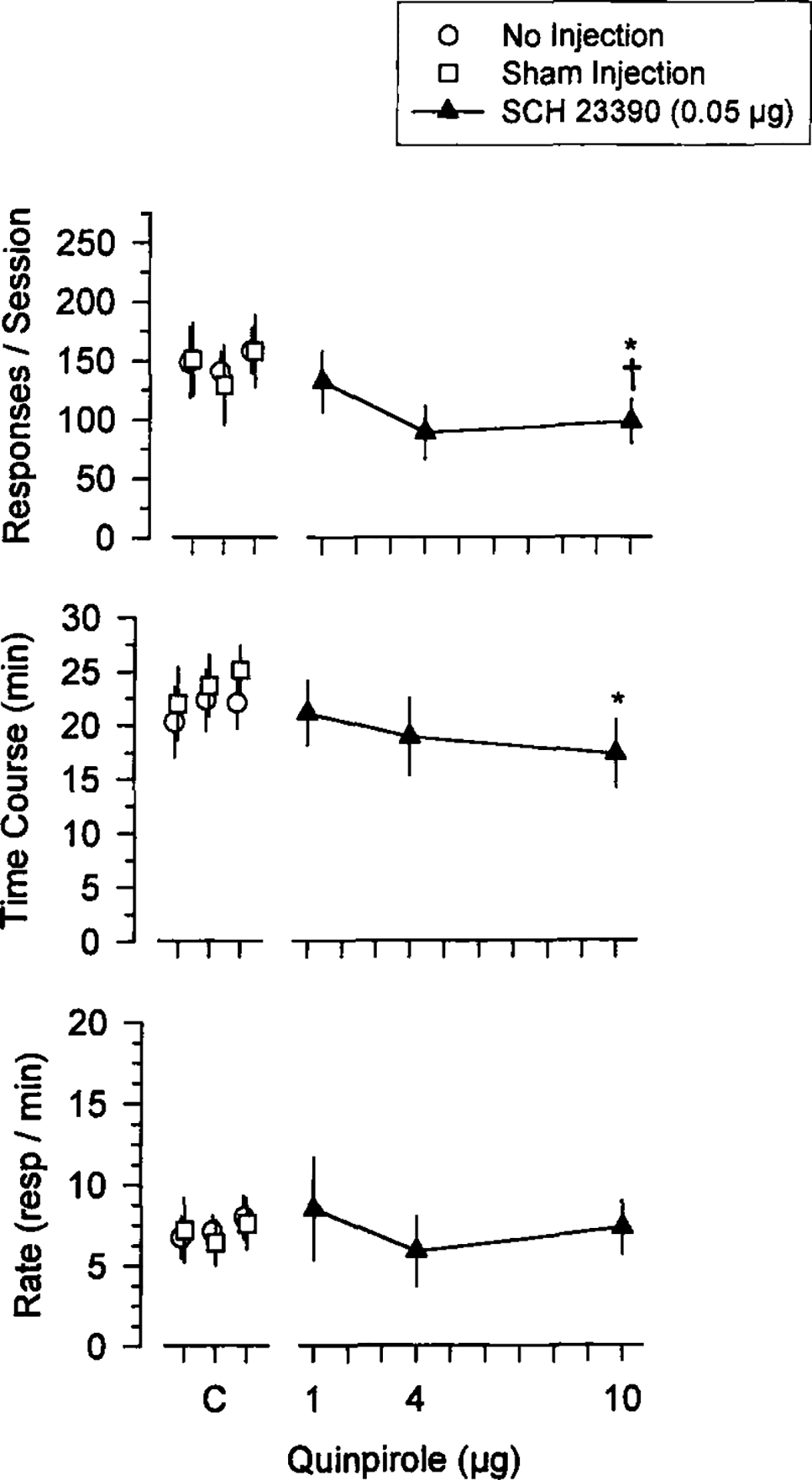
Mean number of ethanol-reinforced responses (top), time course of responding (middle), and response rate (bottom) for n = 9 animals plotted as a function of quinpirole doseage when co-administered with SCH 23390. Because the behavioral baseline shifted during the course of the experiment, data from control (C) sessions (no-injection and sham injection) from each corresponding weekly drug injection are shown on the left of the x-axis break. The left control point is for the lowest drug dose, the center control point for the middle drug dose, and the right control point for the highest drug dose. Error bars are ±SEM. * Significantly different from no injection. † Significantly different from sham control (p < 0.05, Student-Newman-Keuls test).
SKF 38393 or SCH 23390 and Raclopride
When administered alone in the N Acc, the D2 antagonist raclopride significantly reduced total ethanol-reinforced responding at the 1.0 μg dose as a result of decreases in time course and response rate (Fig. 5). When SKF 38393 (0.03 μg) was combined with the low dose of raclopride (0.1 μg), total responding was decreased greater than with either drug alone. This potentiated effect of combined administration was a result of decreased response rate. However, when SKF 38393 was combined with the 1.0 μg raclopride dose, no change over the raclopride effect alone was observed. Co-administration of SCH 23390 with either dose of raclopride did not alter the effects on total responding observed after raclopride alone, but at the high raclopride dose, blocked the raclopride effect of decreasing the rate of responding (Fig. 5).
Fig. 5.
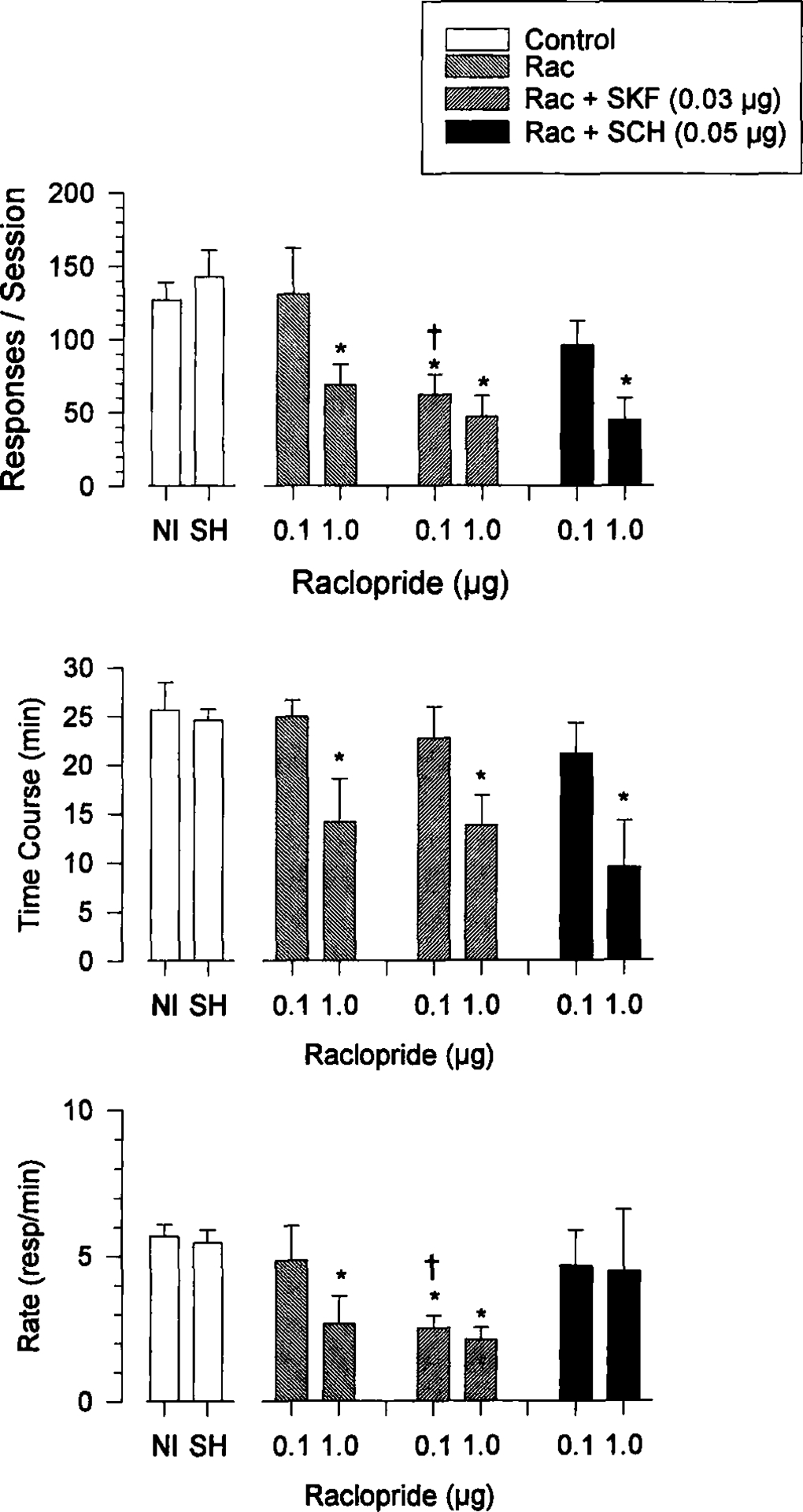
Mean number of ethanol-reinforced responses (top), time course of responding (middle), and response rat (bottom) for n = 8 animals plotted as a function of raclopride (Rac) dosage, and when co-administered with SKF 38393 and SCH 23390. Error bars are ±SEM. * Significantly different from sham injection control. † Significantly different from raclopride alone (p < 0.05, Student-Newman-Keuls test). Nl, no injection control; SH, sham injection control.
DISCUSSION
In the present study, N Acc infusions of the D2 agonist quinpirole resulted in a biphasic effect on ethanol self-administration. The low dose of quinpirole (1.0 μg) increased self-administration as a function of increased response rate. Higher doses of quinpirole (4.0 and 10.0 μg) decreased self-administration by a reduction in the time course of ethanol-reinforced responding with no effect on response rate. No dose of quinpirole affected the onset latency of ethanol-reinforced responding. Thus, stimulation of D2/D3 receptors in the N Acc influenced the maintenance (response rate) and termination (total responding and time course) of ethanol self-administration, but had no effect on the onset (latency) of responding. These data are not in complete agreement with our previous studies that showed increased ethanol self-administration and delayed termination of responding after quinpirole infusions in the N Acc.40,41 The reason for these differences are unclear, but in one of the previous studies,40 session length was 1 hr rather than 30 min, which may account for some of the differences observed.
One interpretation of the changes in responding observed after quinpirole administration is that D2 activation in the N Acc has a direct effect on the process of ethanol reinforcement. In vitro slice preparation studies have shown that quinpirole reduces electrically evoked dopamine release49 Ethanol self-administration increases DA release in the N Acc,11 which is believed to result from activation of DA cell bodies in the VTA.7,8 Thus, there is support for the hypothesis that quinpirole altered ethanol-maintained responding by attenuating the ethanol-evoked DA release in the N Acc. Using this hypothesis, the low dose of quinpirole could have increased total responding by only partially attenuating ethanol-stimulated DA release. The higher doses of quinpirole may have attenuated ethanol’s stimulated release of DA to such an extent that responding terminated early because of a lack of appropriate feedback related to consumption. Using this hypothesis, it could be predicted that, for some doses of quinpirole, the reduction of DA release occurring during the ethanol drinking would be such as to alter consumption rate while prolonging responding, explaining the data observed in our previous studies. This interpretation of data suggests that D2 DA activity within the N Acc is involved in the regulation of maintenance and termination of ethanol self-administration, and the extent of changes in intake resulting from D2/3 agonist action may be dependent on the extent and timing of altered DA activity during an ethanol drinking episode.
Another explanation of the quinpirole data is that changes in ethanol-reinforced responding after quinpirole infusions resulted from nonspecific effects on locomotor behavior.40 data is that changes in ethanol-reinforced Quinpirole (0.3 to 3.0 μg) administration in the N Acc has been shown to increase locomotor activity,3 which could account for the increases in total responding and response rate observed in the present data after the microinjection of the low dose of quinpirole (1.0 μg). However, a higher dose of quinpirole (4.0 μg), similar to one known to also increase locomotor activity,3 decreased ethanol-reinforced responding in the present study without changing response rate. This suggests that nonspecific locomotor-activating effects of quinpirole in the N Acc most likely did not produce the observed decrease in ethanol-maintained responding.
Another hypothesis that might account for the biphasic effect of quinpirole on ethanol-reinforced responding is a possible dose-related differential action at the various DA receptor subtypes due to their affinity for the D2/D3 agonist.13 For example, at the low dose of quinpirole, only the high-affinity type D2 autoreceptors might have been involved,13 whereas at the higher doses, the lower affinity pre- and postsynaptic D2 and D3 receptors might have been activated as well.13 As pointed out by Neisewander et al.,28 it is critical to quantify receptors occupied to make statements regarding receptor subtype sensitivity. It is of interest to note, however, that they28 found differential receptor occupation within the dose range of SCH 23390 used in this study.
Intra-accumbens infusions of the D1 agonist SKF 38393 alone had no effect on any measured parameter of ethanol-reinforced responding at the doses tested. This is in contrast to numerous studies showing that SKF 38393 influenced measures of locomotor, consummatory, and reinforced behaviors. When administered systemically, SKF 38393 reduced alcohol intake in the selected line of high alcohol drinking rats.30 As well, systemic SKF 38393 reduced food intake in rats50–52 and sucrose (10%) sham feeding in rats.53 Both cocaine and food-reinforced lever pressing in squirrel monkeys was reduced after systemic SKF 38393.54 Intra-accumbens infusions of SKF 38393 stimulated motor behavior at doses similar to those tested in this study.55–57 However, a N Acc-microinjected dose of SKF 38393 that enhanced locomotion (1.0 μg) had no effect on quantity of food consumed or other collateral eating behaviors.58 These studies compared with the present study suggest that systemically administered SKF 38393 is most likely acting through DA or other receptor systems [i.e., serotonin (5-HT)] in brain regions other than the N Acc to reduce the intake of alcohol.
N Acc microinjections of the DA D1 antagonist SCH 23390 had no effect on ethanol-reinforced responding at a low dose (0.05 μg), but resulted in significant decreases in total responding and time course at the two higher doses (0.5 and 2.0 μg). Thus, termination of ethanol-reinforced responding may be partly regulated by D, receptor function in the N Acc. SCH 23390 did not alter response rate or latency, suggesting that D1 receptor activation in this brain region is not necessary for either the onset or maintenance of responding. However, because SCH 23390 has binding affinity for 5-HT2 and 5-HTlc receptors,59,60 it is possible that the reductions in ethanol-reinforced responding observed in the present experiment were not specific to D1 receptor blockade.
When administered systemically61 or in the N Acc,62 SCH 23390 decreases locomotor behavior, suggesting that the observed changes in ethanol-reinforced responding may have resulted from nonspecific motor effects. However, reductions in locomotor behavior produced by N Acc infusions of SCH 23390 (0.5 and 2.5 μg) were not accompanied by decreases in heroin self-administration in rats,62 indicating a dissociation of the nonspecific locomotor actions and opioid reinforcement function. This data62 raises the possibility that the observed effect of SCH 23390 in the present study was also not a result of nonspecific motor actions. Taken together with the finding that SKF 38393 produced no effect on ethanol self-administration, the finding that SCH 23390 was able to decrease responding suggests that the process of ethanol reinforcement may be partly dependent on tonic D1 receptor function, but is not enhanced by increased D1 stimulation.
Intra-accumbens injections of the D2 antagonist raclopride (1.0 μg) decreased ethanol-reinforced lever pressing by reductions in both time course and response rate. This replicates previous findings in which intra-accumbens infusions of raclopride decreased ethanol41- and sucrose42-reinforced responding similarly when behavioral baselines were matched. In these previous studies, there was a shift to the right in the dose effect curve for sucrose reinforcement, suggesting again that the effects on ethanol responding were not a result of interference with motor performance.
Co-administration of SKF 38393 (0.03 μg) blocked the biphasic effects of the two low doses of quinpirole (1.0 and 4.0 μg) on ethanol-reinforced responding. Although the D1 agonist failed to alter ethanol maintained responding when administered alone, it attenuated the effects of the D2 agonist. This result would seem to be in contrast with the notion that D1 receptor stimulation is required for the expression of D2-mediated effects.21 Electrophysiological experiments have shown that a high percentage of N Acc neurons are insensitive to SKF 38393 alone, but demonstrate a potentiated inhibition after quinpirole application when SKF 38393 is present in the medium.26,63 Synergistic interactions between D1 and D2 receptors have been found in behavioral studies of grooming,25 locomotor activity3,27,64 and stereotypy.55 However, behavioral studies involving reinforcement, such as d-amphetamine self-administration65 and conditioned reinforcement,66 have reported an additive interaction between D1 and D2 receptors. Systemic administration of either quinpirole or SKF 38393 decreased food intake in rats, but the combination did not potentiate the decrease produced by either compound alone.52 It would appear, therefore, that co-administration of SKF 38393 and quinpirole may have a variety of effects which can be either additive or antagonistic, depending on a variety of factors, including the behavior under study.67 With regard to ethanol-reinforced responding, the present data suggest that D1 and D2 receptor stimulation in the N Acc is antagonistic when the D2 agonist effects are expressed. In the dose ranges tested, it seems that, when both agonists bind competitively to their respective receptor subtypes, the efficacy of the D2 agonist to affect ethanol self-administration is decreased.
Co-administration of an ineffective dose of SCH 23390 (0.05 μg) on ethanol self-administration blocked the low-dose increasing effects of quinpirole, but did not prevent the decrease in total responding observed after the higher dose of quinpirole (10.0 μg). Thus, the D1 agonist SKF 38393 and the D1 antagonist SCH 23390 resulted in a similar blockade of the behavioral expression of the low dose D2 agonist effects. This suggests that some level of tonic DA stimulation of D1 receptors in the N Acc may be necessary for the low-dose effects of the D2 agonist on ethanol-reinforced responding to be observed.
The present data show that co-administration of ineffective doses of the D1 agonist SKF 38393 (0.03 μg) with raclopride (0.1 μg) resulted in an enhancement of the response rate decreasing effects of the D2 antagonist. This suggests quantitative synergism68 in the expression of the D2 antagonist-induced effects on ethanol-reinforced responding. The D1 antagonist SCH 23390 did not affect the behavioral effects of raclopride. These data suggest that the expression of D2 antagonist-induced effects on ethanol-reinforced responding are enhanced by stimulation of D1 receptors, but are not dependent on D1 receptor function.
The behavioral effects (i.e., increased time course and decreased response rate) produced by the co-administration of SKF 38393 with the high dose of quinpirole were similar to previous studies that examined the effects of intra-accumbens infusions of the nonspecific mixed agonist d-amphetamine40,41 This result could be explained based on the hypothesis that relative levels of D1 and D2 activity may determine the particular form of behavioral expression.69 However, added studies are required to test this hypothesis.
One important finding of the present study is that none of the DA agonists or antagonists, at the doses tested alone or in combination, influenced the onset of ethanol self-administration (i.e., latency of the first response). In the operant behavioral situation, discriminative stimuli set the occasion for (i.e., signal) response sequences that have a higher probability of resulting in the availability of a reinforcer. The role of the N Acc in behavioral control by conditioned stimuli has been demonstrated by several different studies. For instance, N Acc infusions of d-amphetamine enhanced responding that resulted in presentation of a conditioned reinforcer.70,71 Increases in extracellular DA in the N Acc have been observed preceding the onset of an alcohol self-administration session when the animals are placed into the operant apparatus in which they have previously received ethanol reinforcement.11 Thus, one proposed function of N Acc is to integrate the actions of discriminative stimuli and/or conditioned reinforcers in the organization of motor activity.72 However, the present data suggest that DA transmission in the N Acc is not involved in regulating the onset of ethanol self-administration, which would not support a role for DA specifically in the initial events that control an ethanol consumption event. In conclusion, data from the present study demonstrate that D1 and D2 receptors in the N Acc are involved in the maintenance and termination, but not onset, of ethanol-reinforced responding in a limited access operant paradigm.
Acknowledgments
This research was supported by Grants AA07404 and AA00142 (to H.H.S.) from the National Institute on Alcohol Abuse and Alcoholism.
REFERENCES
- 1.Colle L, Wise RA: Concurrent facilitory and inhibitory effects of amphetamine on stimulation-induced eating. Brain Res 459:356–360, 1988 [DOI] [PubMed] [Google Scholar]
- 2.Evans KR, Vaccarino FJ: Intra-nucleus accumbens amphetamine: Dose dependent effects on food intake. Pharmacol Biochem Behav 27: 1149–1151, 1986 [DOI] [PubMed] [Google Scholar]
- 3.Dreher JK, Jackson DM: Role of D1 and D2 dopamine receptors in mediating locomotor activity elicited from the nucleus accumbens of rats. Brain Res 487:267–277, 1989 [DOI] [PubMed] [Google Scholar]
- 4.Salamone JD: The involvement of nucleus accumbens dopamine in appetitive and aversive motivation. Behav Brain Res 61:117–133, 1994 [DOI] [PubMed] [Google Scholar]
- 5.Koob GF: Drugs of abuse: Anatomy, pharmacology and function of reward pathways. Trends Pharmacol Sci 13:177–184, 1992 [DOI] [PubMed] [Google Scholar]
- 6.Caine SB, Heinrichs SC, Coffin VL, Koob GF: Effects of the dopamine D-l antagonist SCH 23390 microinjected into the accumbens, amygdala or striatum on cocaine self-administration in the rat. Brain Res 692:47–56, 1995 [DOI] [PubMed] [Google Scholar]
- 7.Gessa GL, Muntoni F, Collu M, Vargui L, Mereu G: Low doses of ethanol activate dopaminergic neurons in the ventral tegmental area. Brain Res 348:201–203, 1985 [DOI] [PubMed] [Google Scholar]
- 8.Brodie MS, Schefner SA, Dunwiddie TV: Ethanol increases the firing rates of dopamine neurons of the rat ventral tegmental area in vitro. Brain Res 508:65–69, 1990 [DOI] [PubMed] [Google Scholar]
- 9.Imperato A, DiChiara G: Preferential stimulation of dopamine release in the nucleus accumbens of freely moving rats by ethanol. J Pharmacol Exp Ther 238:219–228, 1986 [PubMed] [Google Scholar]
- 10.McBride WJ, Murphy JM, Gatto GJ, Levy AD, Yoshimoto K, Lumeng L, Li TK: CNS mechanisms of alcohol self-administration. Alcohol Alcohol 2(Suppl.):463–467, 1993 [PubMed] [Google Scholar]
- 11.Weiss F, Hurd YL, Ungerstedt MA, Plotsky PM, Koob GF: Neurochemical correlates of cocaine and ethanol self-administration, in Kali-vas PW, Samson HH (eds): The Neurobiology of Drug and Alcohol Addiction, vol 654. New York, New York Academy of Science, 1992, pp 220–241 [DOI] [PubMed] [Google Scholar]
- 12.Jarvie KR, Caron MG: Heterogeneity of dopamine receptors. Adv Neurol 60:325–333, 1993 [PubMed] [Google Scholar]
- 13.Seeman P, Van Tol HH: Dopamine receptor pharmacology. Trends Pharmacol Sci 15:264–270, 1994 [DOI] [PubMed] [Google Scholar]
- 14.Waddington JL, Daly SA, Downes RP, Deveney AM, McCauley PG, Oboyle KM: Behavioural pharmacology of ‘Dl-like’ dopamine receptors: Further subtyping, new pharmacological probes and interactions with ‘D2-like’ receptors. Prog Neuropsychopharmacol Biol Psychiatry 19:811–831, 1995 [DOI] [PubMed] [Google Scholar]
- 15.Gehlert DR: Quantitative autoradiography of Gpp(NH)p sensitive and insensitive [3H]quinpirole binding sites in the rat brain. Synapse 14:113–120, 1993 [DOI] [PubMed] [Google Scholar]
- 16.Griffon N, Diaz J, Levesque JD, Sautel F, Schwartz J-C, Sokoloff P, Simon P, Costentin J, Garrido F, Mann A, Camile W: Localization, regulation, role of the dopamine D3 receptor are distinct from those of the D2 receptor. Clin Neuropharmacol 18(Suppl.):S130–S142, 1995 [Google Scholar]
- 17.Larson EC, Ariano MA: D3 and D2 dopamine receptors: Visualization of cellular expression patterns in motor and limbic structures. Synapse 20:325–337, 1995 [DOI] [PubMed] [Google Scholar]
- 18.MacLennan AJ, Lee N, Vincent SR, Walker DW: D2 dopamine receptor mRNA distribution in cholinergic and somatostatinergic cells of the rat caudate-putamen and nucleus accumbens. Neurosci Lett 180:214–218, 1994 [DOI] [PubMed] [Google Scholar]
- 19.Aretha CW, Sinha A, Galloway WP: Dopamine D3-preferring ligands act at synthesis modulating autoreceptors. J Pharmacol Exp Ther 274:609–613, 1995 [PubMed] [Google Scholar]
- 20.Burris KD, Pacheco MA, Filtz TM, Kung M-P, Kung HF, Molinoff PB: Lack of discrimination by agonists for D2 and D3 dopamine receptors. Neuropsychopharmacology 12:335–345, 1995 [DOI] [PubMed] [Google Scholar]
- 21.Clark D, White FJ: Review: D1 dopamine receptor—The search for a function: A critical evaluation of the D1/D2 dopamine receptor classification and its functional implications. Synapse 1:347–388, 1987 [DOI] [PubMed] [Google Scholar]
- 22.Galloway MP, Wolf ME, Roth RH: Regulation of dopamine synthesis in the medial prefrontal cortex is mediated by release modulating autoreceptors: Studies in vivo. J Pharmacol Exp Ther 236:689–698, 1985 [PubMed] [Google Scholar]
- 23.Cooper DMF, Bier-Laning CM, Halford MK, Ahlijanian MK, Zahniser NR: Dopamine, acting through D2 receptors, inhibits rat striatal adenylate cyclase by a GTP-dependent process. Mol Pharmacol 29:113–119, 1986 [PubMed] [Google Scholar]
- 24.Rosengarten H, Schweitzer JW, Friedoff AJ: Selective dopamine D2 receptor reduction enhances a D1 mediated oral dyskinesia in rats. Life Sci 39:29–35, 1986 [DOI] [PubMed] [Google Scholar]
- 25.Murray AM, Waddington JL: The induction of grooming and vacuous chewing by a series of selective D1 dopamine receptor agonists: Two directions of D1:D2 interaction. Eur J Pharmacol 160:377–384, 1989 [DOI] [PubMed] [Google Scholar]
- 26.White FJ: D-l dopamine receptor stimulation “enables” the inhibitory effects of the D-2 agonist quinpirole on rat nucleus accumbens neurons. Eur J Pharmacol 135:101–105, 1987 [DOI] [PubMed] [Google Scholar]
- 27.Essman WD, McGonigle P, Lucki I: Anatomical differentiation within the nucleus accumbens of the locomotor stimulatory actions of selective dopamine agonists and d-amphetamine. Psychopharmacology 112:223–241, 1993 [DOI] [PubMed] [Google Scholar]
- 28.Neisewander JL, O’Dell LE, Redmond JC: Localization of dopamine receptor subtypes occupied by intra-accumbens antagonists that reverse cocaine-induced locomotion. Brain Res 671:201–212, 1995 [DOI] [PubMed] [Google Scholar]
- 29.Rowlett JK, Mattingly BA, Bardo MT: Repeated quinpirole treatment: Locomotor activity, dopamine synthesis, effects of selective dopamine antagonists. Synapse 20:209–216, 1995 [DOI] [PubMed] [Google Scholar]
- 30.Dyr W, McBride WJ, Li TK, Murphy JM: Effects of D1 and D2 dopamine receptor agents on ethanol consumption in the high-alcohol-drinking (HAD) line of rats. Alcohol 10:207–212, 1993 [DOI] [PubMed] [Google Scholar]
- 31.Linesman MA: Effects of dopaminergic agents on alcohol consumption by rats in a limited access paradigm. Psychopharmacology 100: 195–200, 1990 [DOI] [PubMed] [Google Scholar]
- 32.Pfeffer AO, Samson HH: Effect of pimozide on homecage ethanol drinking in the rat: Dependence on drinking session length. Alcohol Depend 17:47–55, 1986 [DOI] [PubMed] [Google Scholar]
- 33.Pfeffer AO, Samson HH: Oral ethanol reinforcement: Interactive effects of amphetamine, pimozide and food-restriction. Alcohol Drug Res 6:37–48, 1985 [PubMed] [Google Scholar]
- 34.Pfeffer AO, Samson HH: Haloperidol and apomorphine effects on ethanol reinforcement in free feeding rats. Pharmacol Bochem Behav 29:343–350, 1988 [DOI] [PubMed] [Google Scholar]
- 35.Brown ZW, Gill K, Abitbol M, Amit Z: Lack of effect of dopamine receptor blockade on voluntary ethanol consumption. Behav Neural Biol 36:291–294, 1982 [DOI] [PubMed] [Google Scholar]
- 36.Brown ZW, Amit Z: The effects of selective catecholamine depletions by 6-hydroxydopamine on ethanol preference in rats. Neurosci Lett 5:333–336, 1977 [DOI] [PubMed] [Google Scholar]
- 37.Myers RD, Melchior CL: Alcohol drinking in the rat after destruction of serotonergic and catecholaminergic neurons in the brain. Res Comm Chem Pathol Pharmacol 10:363–378, 1975 [PubMed] [Google Scholar]
- 38.Richardson JS, Novakovski DM: Brain monoamines and free choice ethanol consumption in rats. Drug Alcohol Depend 3:253–264, 1978 [DOI] [PubMed] [Google Scholar]
- 39.Rassnick S, Stinus L, Koob GF: The effects of 6-hydroxydopamine lesions of the nucleus accumbens and the mesolimbic dopamine system on oral self-administration of ethanol in the rat. Brain Res 623:16–24, 1993 [DOI] [PubMed] [Google Scholar]
- 40.Hodge CW, Haraguchi M, Samson HH: Microinjections of dopamine agonists in the nucleus accumbens increase ethanol-reinforced responding. Pharmacol Biochem Behav 43:249–254, 1992 [DOI] [PubMed] [Google Scholar]
- 41.Samson HH, Hodge CW, Tolliver GT, Haraguchi M: Effects of dopamine agonists and antagonists on ethanol reinforced behavior: The involvement of the nucleus accumbens. Brain Res Bull 30:133–141, 1993 [DOI] [PubMed] [Google Scholar]
- 42.Hodge CW, Samson HH, Tolliver GT, Haraguchi M: Effects of intra-accumbens injections of dopamine agonists and antagonists on sucrose- and sucrose-ethanol reinforced responding. Pharmacol Biochem Behav 48:141–150, 1994 [DOI] [PubMed] [Google Scholar]
- 43.Hodge CW, Haraguchi M, Erickson HL, Samson HH: Microinjections of quinpirole in the ventral tegmentum decrease ethanol reinforced responding. Alcohol Clin Exp Res 17:370–375, 1993 [DOI] [PubMed] [Google Scholar]
- 44.Rassnick S, Pulvirenti L, Koob GF: Oral ethanol self-administration in rats is reduced by the administration of dopamine and glutamate receptor antagonists into the nucleus accumbens. Psychopharmacology 109:92–98, 1992 [DOI] [PubMed] [Google Scholar]
- 45.Samson HH, Hodge CW: Neurobehavioral regulation of ethanol intake, in Deitrich RA (ed): Pharmacological Effects of Ethanol on the Nervous System, vol 13. Boca Raton, FL, CRC Press, 1996, pp 203–226 [Google Scholar]
- 46.Samson HH: Initiation of ethanol reinforcement using a sucrose-substitution procedure in food- and water-sated rats. Alcohol Clin Exp Res 10:436–442, 1986 [DOI] [PubMed] [Google Scholar]
- 47.Paxinos G, Watson C: The Rat Brain in Stereotaxic Coordinates. Sydney, Academic Press, 1982 [Google Scholar]
- 48.Hodge CW, Haraguchi M, Chappelle AM, Samson HH: Effects of ventral tegmental microinjections of the GABAA agonist muscimol on self-administration of ethanol and sucrose. Pharmacol Biochem Behav 53:971–977, 1996 [DOI] [PubMed] [Google Scholar]
- 49.Yamada S, Yokoo H, Nishi S: Differential effects of dopamine agonists on evoked dopamine release from slices of striatum and nucleus accumbens in rats. Brain Res 648:176–179, 1994 [DOI] [PubMed] [Google Scholar]
- 50.Gilbert DB, Cooper SJ: Analysis of dopamine D1 and D2 receptor involvement in d- and 1-amphetamine-induced anorexia in rats. Brain Res Bull 15:385–389, 1985 [DOI] [PubMed] [Google Scholar]
- 51.Terry P, Katz JL: Differential antagonism of the effects of dopamine Dl-receptor agonists on feeding behavior in the rat. Psychopharmacology 109:403–409, 1992 [DOI] [PubMed] [Google Scholar]
- 52.Zarrindast MR, Owji AA, Hosseini-Nia T: Evaluation of dopamine receptor involvement in ratfeeding behaviour. Gen Pharmacol 22:1011–1016, 1991 [DOI] [PubMed] [Google Scholar]
- 53.Cooper SJ, Francis J, Barber DJ: Selective dopamine D-l receptor agonists, SK&F 38393 and CY 208–243 reduce sucrose sham-feeding in the rat. Neuropharmacology 32:101–102, 1993 [DOI] [PubMed] [Google Scholar]
- 54.Katz JL, Witkin JM: Selective effects of the D1 dopamine receptor agonist, SKF 38393 on behavior maintained by cocaine injection in squirrel monkeys. Psychopharmacology 109:241–244, 1992 [DOI] [PubMed] [Google Scholar]
- 55.Amt J, Hyttel J, Perregaard J: Dopamine D1-receptor agonists combined with the selective D-2 agonist quinpirole facilitate the expression of oral stereotyped behaviour in rats. Eur J Pharmacol 133:137–145, 1987 [DOI] [PubMed] [Google Scholar]
- 56.Freedman SB, Wait CP, Woodruff GN: Effects of dopamine receptor agonists and antagonists in the rat nucleus acumbens. Br J Pharmacol 67:430P–431P, 1979 [PMC free article] [PubMed] [Google Scholar]
- 57.Breese GR, Duncan GE, Napier TC, Bondy SC, Iorio LC, Mueller RA: 6-Hydroxydopamine treatments enhance behavioral responses to intracerebral microinjection of Dl- and D2-dopamine agonists into nucleus accumbens and striatum without changing dopamine antagonist binding. J Pharmacol Exp Ther 240:167–176, 1987 [PMC free article] [PubMed] [Google Scholar]
- 58.Phillips GD, Howes SR, Whitelaw RB, Robbins TW, Everitt BJ: Analysis of the effects of intra-accumbens SKF-38393 and LY-171555 upon the behavioral satiety sequence. Psychopharmacology 117:82–90, 1995 [DOI] [PubMed] [Google Scholar]
- 59.Billard W, Ruperto V, Crosby G, Iorio LC, Barnett A: Characterization of the binding of 3H-SCH 23390, a selective D-l receptor antagonist ligand, in the rat striatum. Life Sci 35:1885–1893, 1984 [DOI] [PubMed] [Google Scholar]
- 60.Bischoff S, Heinrich M, Sonntag JM, Krauss J: The D1 dopamine receptor antagonist SCH 23390 also interacts potently with brain serotonin (5-HT2) receptors. Eur J Pharmacol 129:367–370, 1986 [DOI] [PubMed] [Google Scholar]
- 61.Hoffman DC, Beninger RJ: The Dl dopamine receptor antagonist, SCH 23390 reduces locomotor activity and rearing in rats. Pharmacol Biochem Behav 22:341–342, 1985 [DOI] [PubMed] [Google Scholar]
- 62.Gerrits MA, Ramsey NF, Wolterink G, van Ree JM: Lack of evidence for an involvement of nucleus accumbens dopamine Dl receptors in the initiation of heroin self-administration in the rat. Psychopharmacology 114:486–494, 1994 [DOI] [PubMed] [Google Scholar]
- 63.White FJ: Electrophysiological investigation of the D-l dopamine receptor. Clin Neuropharmacol 9:29–31, 1986 [PubMed] [Google Scholar]
- 64.Plaznik A, Stefanski R, Kostowski W: Interaction between accumbens Dl and D2 receptors regulating rat locomotor activity. Psychopharmacology 99:558–562, 1989 [DOI] [PubMed] [Google Scholar]
- 65.Phillips GD, Robbins TW, Everitt BJ: Bilateral intra-accumbens self-administration of d-amphetamine: Antagonism with intra-accumbens SCH-23390 and sulpiride. Psychopharmacology 114:477–485, 1994 [DOI] [PubMed] [Google Scholar]
- 66.Wolterink G, Phillips G, Cador M, Donselaar-Wolterink I, Robbins TW, Everitt BJ: Relative roles of ventral striatal Dl and D2 dopamine receptors in responding with conditioned reinforcement. Psychopharmacology 110:355–364, 1993 [DOI] [PubMed] [Google Scholar]
- 67.Koene P, Prinssen EP, Cools AR: Involvement of the nucleus accumbens in oral behaviour in the freely moving rat. Eur J Pharmacol 233:151–156, 1993 [DOI] [PubMed] [Google Scholar]
- 68.Hu X-T, White FJ: Loss of D1/D2 dopamine receptor synergisms following repeated administration of Dl or D2 receptor selective antagonists: Electrophysiological and behavioral studies. Synapse 17:43–61, 1994 [DOI] [PubMed] [Google Scholar]
- 69.Braun A, Chase TN: Obligatory D-l/D-2 receptor coactivation and the generation of dopamine agonist related behaviors. Eur J Pharmacol 131:301–306, 1986 [DOI] [PubMed] [Google Scholar]
- 70.Taylor JR, Robbins TW: Enhanced behavioral control by conditioned reinforcers following microinjections of d-amphetamine into the nucleus accumbens. Psychopharmacology 84:405–412, 1984 [DOI] [PubMed] [Google Scholar]
- 71.Kelley AE, Delfs JM: Dopamine and conditioned reinforcement. I. Differential effects of amphetamine microinjections into striatal subregions. Psychopharmacology 103:187–196, 1991 [DOI] [PubMed] [Google Scholar]
- 72.Mogenson GJ, Yim CC: Neuromodulatory functions of the mesolimbic dopamine system: Eletrophysiological and behavioral studies, in Willner P, Scheel-Kruger J (eds): The Mesolimbic Dopamine System: From Motivation to Action. New York, Wiley, 1991, pp 106–130 [Google Scholar]