



Abstract
Introduction
Public health systems worldwide face increasing challenges in addressing complex health issues and improving population health outcomes. This experience report introduces the concept of a Learning Public Health System (LPHS) as a potential solution to transform public health practice. Building upon the framework of a Learning Health System (LHS) in healthcare, the LPHS aims to create a dynamic, data‐driven ecosystem that continuously improves public health interventions and policies. This report explores the definition, benefits, challenges, and implementation strategies of an LPHS, highlighting its potential to revolutionize public health practice.
Methods
This report employs a comparative analysis approach, examining the similarities and differences between an LPHS and an LHS. It also identifies and elaborates on the potential benefits, challenges, and barriers to implementing an LPHS. Additionally, the study investigates promising national initiatives that exemplify elements of an LPHS in action.
Results
An LPHS integrates data from diverse sources to inform knowledge generation, policy development, and operational improvements. Key benefits of implementing an LPHS include improved disease prevention, evidence‐informed policy‐making, and enhanced health outcomes. However, several challenges were identified, such as interoperability issues, governance concerns, funding limitations, and cultural factors that may impede the widespread adoption of an LPHS.
Conclusions
Implementation of an LPHS has the potential to significantly transform public health practice. To realize this potential, a call to action is issued for stakeholders across the public health ecosystem. Recommendations include investing in informatics infrastructure, prioritizing workforce development, establishing robust data governance frameworks, and creating incentives to support the development and implementation of a LPHS. By addressing these key areas, public health systems can evolve to become more responsive, efficient, and effective in improving population health outcomes.
Keywords: learning health system, learning public health system, public health
1. INTRODUCTION
A learning health system (LHS) is one in which data collected through clinical care informs research and medical knowledge, which in turn informs clinical care, creating a virtuous cycle. 1 A visual representation of the LHS is shown in Figure 1, adapted from. 2 As noted by Feng et al. 3 the emphasis across definitions of the LHS has shifted over time from healthcare to health systems. Data have remained central; while the original description was focused on data generated in the course of clinical encounters, the 2012 definition and other subsequent framings have expanded in breadth to include a “growing health data infrastructure” 4 and the integration of public health. 5
FIGURE 1.
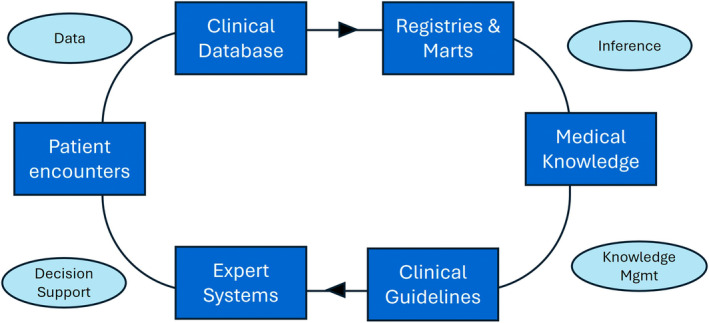
A simplified version of the LHS cycle of data from patient encounters generating medical knowledge and improved care. Adapted from Reference [2] and an unpublished figure shared by Dr. Chris Chute.
In 2018, North Carolina's Department of Health and Human Services (NCDHHS) recognized that the data collected in the course of service delivery should be thought of not merely as a technological by‐product but rather as a strategic business asset. That is, the data collected through public health encounters and service provision may be used to inform public health operations, evaluation, research, and policy‐making. NCDHHS thus created a Data Office in 2019, to be led by the newly created role of Chief Data Officer, in which I had the honor to serve from 2019 to 2024. While the majority of the Data Office's effort was spent on more fundamental tasks, laying the groundwork for data storage, governance, exchange, and use, this vision for a “learning health and human services” system served as a lodestar for our work.
In this experience report, I describe a learning public health system (LPHS), both existing and ideal. I highlight obstacles to an LPHS as well as some promising national initiatives. Finally, I summarize recent NCDHHS successes and ongoing initiatives in this context and conclude with a call to action in four key areas.
1.1. Flavors of knowledge
Figure 1 shows data from clinical encounters being used to generate “Medical Knowledge,” that is, generalizable knowledge that can then be used to inform clinical guidelines, applicable broadly across health systems, at least to other similar populations. For example, EHR data from one or more locations may indicate that a given drug is less effective for people who also take beta blockers. This type of generalizable knowledge may be considered “Knowledge‐with‐a‐capital‐K.” But there is another type of knowledge that may be gained from clinical data: operational knowledge. This may be thought of as “knowledge with a lower‐case k”, applicable for operational purposes for the system in which it was generated. Some examples might be noting that a given clinic tends to run late on Mondays, or a spike in no‐shows on Fridays. This knowledge may or may not be generalizable to other locations, but it is actionable knowledge that can help improve system performance. Throughout this report I will use these different modes of capitalization of the word to indicate broad, generalizable Knowledge versus local operational, but still actionable, knowledge.
1.2. Defining public health, broadly
The CDC Foundation defines public health as “the science of protecting and improving the health of people and their communities” 6 and notes that it is “…achieved by promoting healthy lifestyles, researching disease and injury prevention, and detecting, preventing and responding to infectious diseases.” 6 Public health is thus not only about disease and injury, but also wellness promotion through lifestyle and environment. Accordingly, data that are relevant to public health derive not only from surveillance, surveys, clinical care, or infectious disease prevention and response. As with medicine, recent years have seen recognition in public health of the importance of social determinants of health (SDOH), for example, housing stability, transportation, and access to healthy food. With this broader definition of public health, boundaries start to blur across domains like medicine, public health, and social services. Where enrollment in supplemental nutrition assistance programs or experiencing homelessness was once considered to be outside of the purview of public health, the distinction has become less clear, and arguably less relevant. With increasing focus on “whole person health,” 7 , 8 there is increased recognition of the importance of information regarding all aspects of a person's life, not just the factors that cause a person to schedule a medical appointment, what takes place at that appointment, and the treatment plan that follows.
2. A LEARNING PUBLIC HEALTH SYSTEM
An LPHS may therefore be described as public health system (in the broadest sense, as noted above) with an associated information infrastructure that enables a virtuous cycle. In this cycle, data inform knowledge, which in turn informs policy. The policy is then implemented, generating additional data, which leads to further knowledge. The benefits of a LPHS are numerous and far reaching. It can reduce disease burden through improved targeted prevention, providing real‐world evidence to identify both communities at risk and effective interventions. 9 It can also improve health outcomes through evidence‐informed health policy, sorely lacking in today's landscape despite significant attention and effort. 10 , 11 , 12
As noted in the call for papers for this special issue, public health in theory already exemplifies an LHS in the form of data generation; policy‐making and implementation; and assessment and evaluation, which then feeds into new policy. This approach may be represented by replacing the clinically oriented terms from the boxes in Figure 1 with public health‐oriented terms, for example, COVID vaccine administration goes into an immunization database, which is extracted into a COVID vaccine datamart, that is, a curated database intended for a specific analytic purpose. Data are analyzed to determine new knowledge, for example, women under 50 are at higher risk for adverse events following a specific vaccine. Public health guidelines would specify not to use that vaccine in women under 50, and a clinical decision support alert in the electronic health record could be triggered if a clinician tries to order that vaccine for a patient in the high‐risk group. Thus, in the simplest framing, an LPHS could just be a variation of the LHS applied to areas of medical practice that we think of as public health, for example, immunization, or chronic disease.
It is worth considering what it would look like to go beyond this simple translation. It is not always clear what people mean when they say a policy is “evidence‐based.” 13 Moreover, there is a major gap between what research shows to be effective (i.e., evidence) and which policies are enacted and enforced. 14 Policy‐making is and always will be done based not only on evidence but also on values and politics. 10
Consider a model in which an LPHS can leverage encounter‐based data to generate new knowledge not just regarding clinical guidelines but regarding health policy more broadly. In the LHS/LPHS comparison, there is no EHR analog for policy makers wherein alerts could notify public health officials of best practices. Still, one can envision a future in which a “policy decision support system” could take into account the demographics and climate of a region (both literal and political 12 ) and make recommendations regarding, for example, the most promising policies to apply in a given region, for example, to reduce the spread of disease, or decrease the number of accidental gun‐related deaths. During the COVID pandemic, the Digital Health Institute for Transformation created a proof‐of‐concept data‐driven decision support tool for local government and business leaders. Their “Community Confidence Dashboard” was based on both disease modeling and regional polling regarding preferences, priorities, and risk tolerance. 15
2.1. Partway there: the LPHS of today
Figure 2 gives an overview of an LPHS as it could, and in some cases does, exist today, with a few notable differences from the LHS cycle depicted above. First, encounters related to public health take place in many different settings, through many different systems—local health departments, hospitals, private clinics, social service agencies, and more (Figure 2A). Of course, this is also true for clinical encounters—they may occur at multiple different locations, and the data may or may not be integrated through a regional health information exchange. While a health system will typically have one medical record number (MRN) for each patient, different public health systems often do not have such an ID. This results in more work required to link records between systems (Figure 3B).
FIGURE 2.
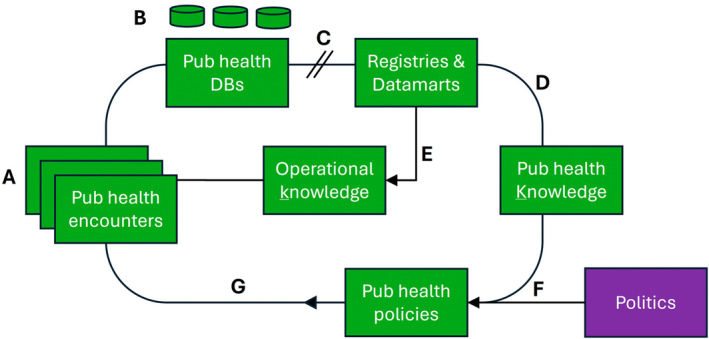
An overview of an LPHS of today. (A). Public health encounters take place in many different locations and contexts. (B). Data are stored in siloed databases without a common identifier for each person. (C). Laws and regulations, or in some cases the cautious interpretation of unclear regulations, make it challenging to aggregate and use data. (D). The outer loop represents generalizable knowledge that may be broadly applied. (E). The inner loop depicts a local, operational learning cycle. (F). In addition to evidence and knowledge, politics plays a part in the development of public health policies and guidelines. (G). Today's LPHS generally lacks the decision support component that exists in clinical care.
FIGURE 3.
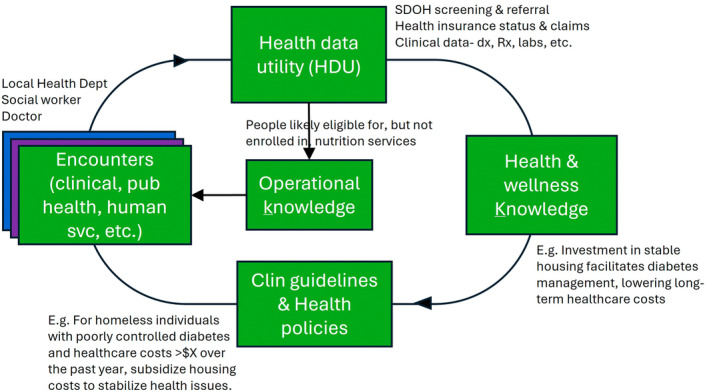
Consolidated vision for a future LPHS. Instead of only public health encounters, encounter types are aggregated for a given individual and stored in a health data utility (HDU) under proper governance. In addition to traditional clinical or public health guidelines, this enables more complex analysis and resulting policies that account for many different facets of a person's experience. Both operational knowledge and generalizable knowledge are used to inform practice.
Once collected, numerous and complex guidelines, regulations, and laws exist at both the local and federal level that limit what may be done with the data, how, and by whom, thus limiting the ability to create the integrated datasets that would be needed for the analyses that would generate new knowledge (Figure 3C).
As noted above, significant public health knowledge has been derived from data collected in the course of public health activities (Figure 2D). The CDC's National Syndromic Surveillance Program collects data from emergency departments, commercial laboratories, and other sources and makes the data available through the BioSense platform for early detection and monitoring. 16 During COVID, the National COVID Cohort Collaborative (N3C) pulled together COVID‐related patient data from ~100 sites, covering 23 M people and almost 9 M COVID cases. 17 This massive datamart enabled numerous retrospective studies, generating new knowledge regarding everything from breakthrough infections 18 to the impact of vaccination on adverse cardiovascular events 19 to the risk of breakthrough COVID cases in cancer patients. 20 Another variation on this cycle is exemplified by the FDA's Sentinel initiative. Sentinel was launched in 2008 to create a federated national electronic system for medical product safety surveillance using claims data as well as data from EHRs. 21 Still, a lack of funding, staffing, skillsets, and incentives yields under‐exploration of the data that do exist.
One notable addition to Figure 2 beyond the single cycle depicted in Figure 1 is the inner loop wherein data are used to generate new operational knowledge (Figure 3E) as opposed to public health knowledge in general. This involves integration and analysis of datasets that have historically remained siloed and unexplored. Examples of such siloes include Medicaid, WIC (special supplemental nutrition program for women, infants, and children), immunizations, and communicable disease cases. If we could leverage the power of that data, integrate and analyze relevant data sources, and have those results generate operational knowledge to inform operational practice and policy evaluation, significant improvements could be made to human health and wellness. Later in this report, I describe some of NCDHHS's successes and ongoing initiatives to this end.
Another notable addition to the diagram is politics, and its shared role with evidence in influencing policy (Figure 2F). The final difference is a subtraction from the original diagram: the box for expert systems. Public health policy execution has no real decision support analog (Figure 2G).
3. BARRIERS TO A LEARNING PUBLIC HEALTH SYSTEM
Unfortunately, there are several obstacles that make it more difficult to achieve both levels of an LPHS—creation of local, operational knowledge, or generalizable knowledge.
3.1. Interoperability
Perhaps, the most obvious obstacle is the extent to which data remain siloed in their place of origin—clinical data in the EHR and public health data in public health systems. But note that interoperability issues are not limited to the space between clinical and public health systems. As described above, underfunding and legacy technology make interoperability a challenge even between systems that fall squarely in the traditional public health domain, for example, immunizations and communicable diseases. This made it more challenging than one might expect to identify post‐vaccination cases shortly after the first COVID vaccines were made available. More resources and technical assistance are required to improve interoperability both within and between domains.
Even for data that are shared, barriers to interoperability remain. One such obstacle is the lack of use of data terminology standards. 22 Information as seemingly simple as smoking status can be collected in many ways—current/past/never vs. light/heavy vs. packs per day. Beyond semantic data standards, it can be challenging to link single individual's records from different systems. A national health identifier would both reduce the amount of unnecessary work being done to link records, and help improve privacy and security. 23 During COVID, for example, had there been a readily available, efficient way to link records from North Carolina's COVID vaccine management system, COVID cases, and clinical information from the state health information exchange (HIE), doing so would have facilitated data quality improvement among each of these sources and provided a robust basis for analysis regarding post‐vaccination cases, potential side effects, and vaccine protocol adherence.
3.2. Governance
One important consideration in the design and development of an LPHS is data privacy. The benefits described above are all real but derived from best‐case scenarios. It is critical to hire skilled IT and data security staff (who, it should be noted, could earn significantly more money in the private sector) to keep data safe and defend against breaches. Even without the issue of a security breach, people may be concerned about what will, or could, be done with their data, whether under a current or future government administration.
Another issue under the broader umbrella of data governance is data quality. We are all familiar with the phrase “garbage in, garbage out.” That is, if the data being used for any given analysis or model training are of poor quality, then the results will similarly be of poor quality. Of course, any large dataset is likely to have its own challenges when it comes to data quality. Data need not be perfect, but it must be evaluated for quality, and deemed “fit for use” before it can be put to work. Data used for analysis without formal quality profiling, assessment, or improvement introduce a significant risk.
3.3. Funding
COVID notwithstanding, public health has been historically underfunded. In addition to frequently antiquated technology, this underfunding has resulted in extremely high vacancy rates as skilled professionals leave the workforce, whether due to burn‐out following the pandemic, the allure of higher salaries in nongovernment jobs, or other reasons. 24 , 25 With staff stretched so thin covering the responsibilities of vacant positions, there is little to no bandwidth for any given unit to work with data to improve operations.
Another challenge is the disease‐ and domain‐based nature of funding. It can be easier to persuade funders, including lawmakers overseeing a budget, to allocate money, for example, to hungry children, isolated seniors, or people with substance use disorders. It is more challenging to secure funding for infrastructure that spans multiple areas, benefiting all but belonging to no single domain.
3.4. Culture
Public health, and epidemiology more broadly, has been a data‐driven domain from the time of John Snow's investigation into cholera outbreaks in London in the 1850s. Given that, one might expect a culture of data sharing for purposes of deriving new knowledge. Countering this tendency toward data use are: (1) privacy issues around data that are sometimes particularly sensitive, for example, HIV or syphilis status, (2) confusing and contradictory laws and regulations, leading to sometimes overly cautious legal interpretation, and (3) an academic flavor in some departments that inspires a territorial approach to data, lest a researcher get “scooped”, that is, someone else publishes findings using the data before the person who works in the unit that collected it has a chance to publish.
While a sense of stewardship and privacy protection is a good thing, it should ideally be balanced with a tendency to leverage that data to the greatest extent possible through inspection and analysis. 26 Executive‐level buy‐in and close coordination with legal counsel can help transform a culture of caution to one of “getting to yes” with respect to appropriate data governance, exchange, integration, and analysis. 26
4. PROGRESS THROUGH KEY INITIATIVES
Three notable current initiatives are steps in the right direction.
4.1. The data modernization initiative (DMI)
The CDC's Data Modernization Initiative (DMI) is a multiyear, multibillion dollar effort to modernize data across the public health landscape with priorities that include “building the right foundation” by improving data analysis, collection, and sharing, and “accelerating data into action.” 27
Included in the DMI are two specific technology‐enabled systems that are critical to building out an LPHS: electronic lab reporting (ELR) and electronic case reporting (eCR). ELR is the electronic transmission of laboratory reports from testing facilities to public health departments, healthcare systems, and the CDC. 28 Electronic case reporting (eCR) sends case data electronically and automatically, based on specific diagnosis codes, between EHRs and public health agencies. While the COVID pandemic served to accelerate adoption of these systems, they are still not universal across facilities. 29
4.2. TEFCA
TEFCA stands for the “Trusted Exchange Framework and Common Agreement.” It is an initiative of the US Office of the National Coordinator for Health Information Technology (ONC) that aims to establish a nationwide HIE infrastructure enabling secure and seamless exchange of health information across different health information networks. Included in the stated goals is simplifying connectivity to “enhance the welfare of populations.” 30 Beyond clinical care, TEFCA is relevant to public health as it aims to facilitate timely exchange of health data that are critical for disease surveillance, outbreak detection, and population health management.
4.3. Health data utilities
A health data utility (HDU) is a relatively new concept that may be described informally as “an HIE on steroids.” Where an HIE includes clinical data from multiple sources to form a longitudinal record for purposes of clinical care, an HDU goes beyond clinical data as a source to incorporate clinical, public health, SDOH, claims, administrative, and other relevant data 31 and beyond clinical care as a purpose to include goals such as public health, research, etc. Some HIEs are already functioning like HDUs in some ways. With the right governance structure around them, HDUs could serve as a foundational component of an LPHS (See Figure 3).
5. NCDHHS ADVANCES TOWARD AN LPHS
As noted, the NCDHHS Data Office was established in 2019. From an organizational perspective, it was situated in the Office of the Secretary, with its scope extending across the entire department. (Notably, and importantly for the strategic business nature of the unit, it was not created under the Information Technology Division). With a virtuous learning cycle as the lodestar, the team began by developing a data strategy framework. The framework was made up of four pillars: (1) data use; (2) data infrastructure; (3) data governance; and (4) data literacy.
Data use cases were defined by the business units. The Data Office was particularly focused on use cases that required collaboration between different divisions. Some examples are provided in Table 1. Answering each of these questions resulted in new, actionable knowledge within NCHHS.
TABLE 1.
Examples of data‐driven business unit questions formed the basis for the “data use” pillar of NCDHHS's Data Strategy Framework. The Data Office focused primarily on assisting in use cases that required collaboration across divisions.
| Question | Stakeholder divisions | Notes |
|---|---|---|
| What % of Medicaid managed care beneficiaries have been vaccinated against COVID? | Medicaid & Public Health | Enabled accountability for managed care insurance companies. Normally Medicaid claims data would be sufficient, but vaccinations were not reliably billed to Medicaid early in the pandemic. |
| Who is likely eligible for, but not enrolled in, a given service, who might benefit from targeted outreach and information? | Public Health, Medicaid, Social Services | Identifying likely‐eligible‐but‐not‐enrolled individuals and families enabled targeted outreach via text message to increase enrollment. |
| What are the demographics of individuals experiencing behavioral health emergency department boarding across the state? | Public Health, Mental Health | Knowing the breakdown of children vs. adults across regions helped inform resource allocation and strategic location of crisis care facilities in regions of greatest need. |
| Are there individuals who have screened positive for food scarcity and are likely eligible for nutrition services but not yet enrolled? | Public Health, Social Services | Knowing the answer to this question enabled identification of individuals for targeted outreach to increase enrollment. |
Note: The term “behavioral health ED boarding” is when a patient with a behavioral health crisis is kept in an emergency department (ED) for days or even weeks until a spot in an appropriate psychiatric facility becomes available.
5.1. Data infrastructure
The arrival of a global pandemic approximately 9 months after the creation of the Data Office stalled some aspects of the data strategy roadmap, but accelerated others. Shortly after the declaration of the public health emergency (short by government standards), NCDHHS was able to deploy a cloud‐based enterprise data warehouse that facilitated automated daily updates of multiple complex public‐facing dashboards. This central storage also facilitated integrative analysis of data from multiple different divisions in order to answer questions that were previously challenging if not impossible to address.
5.2. Data governance
A landscape analysis by an external consultant resulted in a new legal framework and “Data Sharing Guidebook”, optimized for efficient and appropriate data sharing across the department, thus facilitating integrative analysis and use of data. 32 , 33 The team also created a Data Asset Inventory dashboard to facilitate data asset discovery across the department. Data quality profiling was performed to evaluate validity and missingness for equity‐related data elements (e.g., age, race, ethnicity, preferred language, sexual orientation, gender identity, and sex assigned at birth) across a dozen data assets. Experience has shown that only used data become clean data, and expanded data quality analysis and improvement is ongoing. The team also put significant effort into entity resolution and record linkage, mapping records from multiple siloed data systems to a common unique identified for individuals, thus moving toward a “whole person health” perspective of residents of North Carolina.
With high‐quality metadata regarding existing data assets, a governance and legal framework to facilitate data sharing, and the ability to link records between systems, the department is now better situated to leverage its considerable data assets in deriving new knowledge.
5.3. Data literacy
Finally, NCDHHS partnered with North Carolina State University's Data Science Academy to offer advanced data training through three training modules: advanced Excel, PowerBI, and a capstone module in which students applied what they had learned to data challenges in the context of their job responsibilities. This experience gave staff the skills they needed to leverage data within their respective business units to generate insights and improve operations. Feedback was quite positive, and the training will be expanded moving forward.
One capstone project enabled visualization of demographic and incident data across state‐operated health facilities, enabling the detection of outlying facilities or time periods for investigation. Another project produced a dashboard to facilitate identification of fraudulent Medicaid claims based on combinations of date and location of service, diagnosis codes, date of birth, and other factors. Improbable claims could be double checked for veracity, for example, a low urgency visit recorded on Christmas day.
All of the accomplishments above helped NCDHHS to become a more data‐driven organization, building a virtuous learning cycle in which data collected through daily health and human services operations were used to derive new, actionable knowledge, which informed future operations, which generated new data.
6. LONG‐TERM VISION: THE LPHS OF TOMORROW
The high‐level vision for a future LPHS shown in Figure 3 illustrates the convergence of health data from across the health and human services landscape. Encounters become person‐centric rather than segregated by which provider or local government entity provided the service. A significant portion of the data that can affect an individual's health and well‐being can be integrated and aggregated (where permitted by law) in a HDU with appropriate governance. That data may then be used both to inform improved operations, and to derive new knowledge to improve health and wellness. Politics will always play a role, but with sufficiently robust data, inference, knowledge management, and decision support, perhaps its weight of influence can be decreased. Moreover, one can hardly write a paper in the year 2024 and not mention the potential AI benefits on the horizon. In addition to LLM‐enabled information extraction, more “traditional” machine learning algorithms and predictive models are being developed every day. These advances will further promote the cycle of public health data and evidence‐based policy.
7. CALL TO ACTION
In order to achieve the vision of an LPHS, generating both “capital‐K” knowledge (i.e., generalizable knowledge to be applied across populations) and lower‐case‐k knowledge (i.e., actionable operational knowledge to be applied within a given public health department), actions must be taken to address the barriers described above across four key areas: informatics; workforce development and training; ethical, legal, and social issues; and funding and incentives.
7.1. Informatics
Although the CDC's DMI is a major step in the right direction, its work is ongoing. Its impact is not yet widespread enough to support a true LPHS. Clinical care and public health data and systems are still woefully segregated. Another important informatics obstacle is the lack of a national health identifier. 23 Congress should reject language in Section 510 of the 2025 appropriations bill that continues to ban funding even to explore the creation of a national unique patient identifier.
Finally, the identification and adoption of data standards across public health, and in alignment with healthcare systems, is critical for every step of the LPHS cycle. Note, the need is not for the development of standards—the standards exist. If anything, there are too many. The important undertaking is to identify, with stakeholder input, which standard to use from the many fine standards out there, and then to disseminate that information, as well as offer technical assistance to those who wish to adopt those standards but are unsure how to proceed. 34
7.2. Workforce development and training
One current strength is that there is a large, talented, and dedicated workforce of epidemiologists across the country, who strive to use data to inform public health policy and practice. Where the current workforce landscape falls short is in the dearth of other scientists involved in this space, particularly data scientists. This is an area of both great need and great opportunity for collaboration with data scientists, informaticians, statisticians, computer scientists, and others. Training programs in data science with a focus on public health, including certificates and master's programs, will help to train the future workforce in this critical space. In addition, outreach at the undergraduate and even high school level to make people aware of this area of study would help build a more robust workforce pipeline.
Data literacy is also needed for staff across health‐ and human service‐related government agencies—local, state, and federal. This includes not only advanced training for analysts and epidemiologists but also applies to leadership and decision makers to ensure they understand how to interpret basic graphs and increasingly sophisticated data visualizations. Training is also useful for legal counsel and procurement staff to ensure familiarity with, and an understanding of the importance of, concepts such as application programming interfaces (APIs) and data standards, which might otherwise be overlooked in contract development.
7.3. Ethical, legal, and social issues
One major challenge in data sharing and use is the very complicated landscape of federal and state regulations regarding what is allowable. For example, FERPA (Family Educational Rights and Privacy Act) is a federal law intended to protect the privacy of student education records. Educational data fall under the broad scope of public health in the context of chronic absenteeism, among other ways. The state of Connecticut has its own student privacy law, Public Act 16–189, that is generally more restrictive and prescriptive than FERPA in terms of agreements required, what data are included in the definition of “student information”, and breach notification requirements. These regulations are sometimes even in conflict with each other. Simplifying the rules and aiming for greater alignment would help greatly.
Finally, Mandl et al. argue for a “substantive role” for the patient in the creation of TEFCA including the ability to configure what is shared about them. 35 A similar approach would be advisable for all components of an LPHS. There are some who say that in the era of the internet and social media, privacy is dead. Others will fight tooth and nail for their right to privacy. Ideally, the system is set up “at the speed of trust” with stakeholder input and trust relationships such that people feel comfortable with the way the data are collected, stored, and used. But there will always be those who do not want their data included. For their sake, and for the sake of those who want the benefit from the system and would lose out if the whole approach was to be abandoned, there should be the ability to opt out of having one's data used. As we move toward increased interoperability and ethical data exchange, accounting for the ability of privacy enthusiasts to withhold their personal data from such systems may assuage concerns from privacy advocates.
7.4. Funding and incentives
I have noted above several areas in which ongoing or increased investment is needed—the CDC's DMI, workforce development and data literacy training, and data governance and management.
The establishment of an LPHS is likely to be accelerated by financial incentives for the adoption of the modern infrastructure described above: ELR, eCR, HIEs, TEFCA, HDUs, and more. To this end, North Carolina and California have passed laws requiring data sharing with HIEs by providers and health plans. 36 Paired with these statutory requirements are financial incentive programs, for example, increased Medicaid payment to hospitals that share data with an HIE. 36 Additional statutes and funding across the country are needed to keep things moving in the right direction.
8. CONCLUSIONS
The concept of an LPHS represents a paradigm shift in the way we approach public health. By leveraging data to inform knowledge generation, policy development, and operational improvements, LPHS has the potential to significantly enhance our ability to protect and improve the health of individuals and communities.
Throughout this paper, I have explored the foundations of an LPHS, including its definition, key components, and the benefits it offers. I have also discussed the challenges that stand in the way of realizing the full potential of LPHS, such as interoperability issues, governance concerns, funding limitations, and cultural factors.
Moving forward, there is a clear call to action for stakeholders across the public health ecosystem. Investments in informatics infrastructure, workforce development, data governance, and incentive alignment are needed to support the development, implementation, and advancement of the LPHS. Collaboration and coordination among government agencies, healthcare providers, researchers, and other stakeholders will be essential.
In the long term, the vision of a fully realized LPHS holds great promise. By modernizing infrastructure, integrating health data from across the health and human services landscape, and leveraging advanced technologies such as artificial intelligence, we can create a dynamic system that continuously learns and adapts to improve health outcomes and address the evolving needs of our communities. The journey toward an LPHS is ongoing, but the potential benefits are clear. By working together and committing to the principles of continuous learning, innovation, and collaboration, we can build a healthier future for all.
CONFLICT OF INTEREST STATEMENT
The author has no conflict of interest to declare.
ACKNOWLEDGMENTS
The author would like to thank the amazing public servants at the North Carolina Department of Health and Human Services, particularly members of the Data Office whose tireless efforts enabled the achievements described in the section titled “NCDHHS Advances Toward an LPHS”: Amy Hawn Nelson, Hayley Young, Lorelle Yuen, Katherine Lockett, Robin Jones, Brad Wheeler, Jeremy Brooks, Allison Roshon Arellano, and Ashritha Dandam. Thanks also to Zack Wortman, David Chen, Babita Savitsky, Sam Gibbs, and Charles Carter for early assistance and setting the Data Office up for success. Thank you to Tracy Zimmerman, Kody Kinsley, and Betsey Tilson. Finally, thank you to Mandy Cohen for the opportunity to do this work in the first place, and for the conversation that planted the first seeds of this paper.
Tenenbaum JD. Accelerating a learning public health system: Opportunities, obstacles, and a call to action. Learn Health Sys. 2024;8(4):e10449. doi: 10.1002/lrh2.10449
REFERENCES
- 1. McGinnis JM, Smith M, Saunders R, Stuckhardt L. Best Care at Lower Cost: the Path to Continuously Learning Health Care in America. National Academies Press; 2013. [PubMed] [Google Scholar]
- 2. Chute CG, Cohn SP, Campbell JR. A framework for comprehensive health terminology systems in the United States: development guidelines, criteria for selection, and public policy implications. ANSI healthcare informatics standards board vocabulary working group and the computer‐based patient records institute working group on codes and structures. J Am Med Inform Assoc. 1998;5(6):503‐510. [DOI] [PMC free article] [PubMed] [Google Scholar]
- 3. Feng P, Di Ruggiero E, Reid R, Pinto A, Upshur R. Public Health and Learning Health Systems White Paper. University of Toronto; 2021. [Google Scholar]
- 4. Greene SM, Reid RJ, Larson EB. Implementing the learning health system: from concept to action. Ann Intern Med. 2012;157(3):207‐210. [DOI] [PubMed] [Google Scholar]
- 5. Bernstein JA, Friedman C, Jacobson P, Rubin JC. Ensuring public health's future in a national‐scale learning health system. Am J Prev Med. 2015;48(4):480‐487. [DOI] [PubMed] [Google Scholar]
- 6. CDC Foundation . Introduction to Public Health. 2021. https://www.cdc.gov/training/publichealth101/public-health.html
- 7. The time is now for a whole‐person health approach to public health. Public Health Rep. 2023;138(4):561‐564. [DOI] [PMC free article] [PubMed] [Google Scholar]
- 8. Tilson EC, Muse A, Colville K, Cole A, Koller CF. Investing in whole person health: working toward an integration of physical, behavioral, and social health. N C Med J. 2020;81(3):177‐180. [DOI] [PubMed] [Google Scholar]
- 9. Winston FK, Puzino K, Romer D. Precision prevention: time to move beyond universal interventions. Inj Prev. 2016;22(2):87‐91. [DOI] [PubMed] [Google Scholar]
- 10. Cairney P, Oliver K. Evidence‐based policymaking is not like evidence‐based medicine, so how far should you go to bridge the divide between evidence and policy? Health Res Policy Syst. 2017;15(1):35. [DOI] [PMC free article] [PubMed] [Google Scholar]
- 11. Evans BA, Snooks H, Howson H, Davies M. How hard can it be to include research evidence and evaluation in local health policy implementation? Results from a mixed methods study. Implement Sci. 2013;8:17. [DOI] [PMC free article] [PubMed] [Google Scholar]
- 12. Liverani M, Hawkins B, Parkhurst JO. Political and institutional influences on the use of evidence in public health policy. A systematic review. PLoS One. 2013;8(10):e77404. [DOI] [PMC free article] [PubMed] [Google Scholar]
- 13. Baicker K, Chandra A. Evidence‐based health policy. N Engl J Med. 2017;377(25):2413‐2415. [DOI] [PubMed] [Google Scholar]
- 14. Brownson RCP, Chriqui JFP, Stamatakis KAPMPH. Understanding evidence‐based public health policy. Am J Public Health. 2009;99(9):1576‐1583. [DOI] [PMC free article] [PubMed] [Google Scholar]
- 15. Transformation, D.H.I.f . Community confidence. Community Confidence. https://communityconfidence.org/
- 16. CDC . BioSense Platform. National Syndromic Surveillance Program (NSSP); 2024. [Google Scholar]
- 17. Haendel MA, Chute CG, Bennett TD, et al. The national COVID cohort collaborative (N3C): rationale, design, infrastructure, and deployment. J Am Med Inform Assoc. 2021;28(3):427‐443. [DOI] [PMC free article] [PubMed] [Google Scholar]
- 18. Anzalone AJ, Sun J, Vinson AJ, et al. Community risks for SARS‐CoV‐2 infection among fully vaccinated US adults by rurality: a retrospective cohort study from the national COVID cohort collaborative. PloS ONE. 2023;18(1):e0279968. [DOI] [PMC free article] [PubMed] [Google Scholar]
- 19. Jiang J, Chan L, Kauffman J, et al. Impact of vaccination on major adverse cardiovascular events in patients with COVID‐19 infection. J Am Coll Cardiol. 2023;81(9):928‐930. [DOI] [PMC free article] [PubMed] [Google Scholar]
- 20. Song Q, Bates B, Shao YR, et al. Risk and outcome of breakthrough COVID‐19 infections in vaccinated patients with cancer: real‐world evidence from the national COVID cohort collaborative. J Clin Oncol. 2022;40(13):1414‐1427. [DOI] [PMC free article] [PubMed] [Google Scholar]
- 21. Platt R, Brown JS, Robb M, et al. The FDA sentinel initiative – an evolving National Resource. N Engl J Med. 2018;379(22):2091‐2093. [DOI] [PubMed] [Google Scholar]
- 22. Richesson RL, Chute CG. Health information technology data standards get down to business: maturation within domains and the emergence of interoperability. J Am Med Inform Assoc. 2015;22(3):492‐494. [DOI] [PMC free article] [PubMed] [Google Scholar]
- 23. Alder S. Editorial: time to stop blocking a national patient identifier system. HIPAA J. 2023. [Google Scholar]
- 24. Leider JP, Castrucci BC, Robins M, et al. The exodus of state and local public health employees: separations started before and continued throughout COVID‐19. Health Aff (Millwood). 2023;42(3):338‐348. [DOI] [PubMed] [Google Scholar]
- 25. Leider JP, Yeager VA, Kirkland C, Krasna H, Hare Bork R, Resnick B. The state of the US public health workforce: ongoing challenges and future directions. Annu Rev Public Health. 2023;44:323‐341. [DOI] [PubMed] [Google Scholar]
- 26. Proescholdbell S, Geary S, Tenenbaum JD. Data governance and the need for organization‐wide guidance to enable and facilitate data sharing: lessons learned from North Carolina. J Public Health Manag Pract. 2022;28(5):442‐444. [DOI] [PubMed] [Google Scholar]
- 27. Jernigan DB. CDC's Data Modernization Initiative… Changing the Way we Work. CDC Foundation; 2022. [Google Scholar]
- 28. Samoff E, Fangman MT, Fleischauer AT, Waller AE, MacDonald PDM. Improvements in timeliness resulting from implementation of electronic laboratory reporting and an electronic disease surveillance system. Public Health Rep. 2013;128(5):393‐398. [DOI] [PMC free article] [PubMed] [Google Scholar]
- 29. Knicely K, Loonsk JW, Hamilton JJ, Fine A, Conn LA. Electronic case reporting development, implementation, and expansion in the United States. Public Health Rep. 2024;139:432‐442. [DOI] [PMC free article] [PubMed] [Google Scholar]
- 30. Adler‐Milstein J, Worzala C, Dixon BE. Chapter 21 – future directions for health information exchange. In: Dixon BE, ed. Health Information Exchange. Second ed. Academic Press; 2023:447‐468. [Google Scholar]
- 31. Seidman G, AlKasir A, Ricker K, Lane JT, Zink AB, Williams MA. Regulations and funding to create Enterprise architecture for a Nationwide health data ecosystem. Am J Public Health. 2024;114(2):209‐217. [DOI] [PMC free article] [PubMed] [Google Scholar]
- 32. Department of Health and Human Services North Carolina . NCDHHS Data Sharing Guidebook. Department of Health and Human Services North Carolina; 2023. [Google Scholar]
- 33. Nelson AH. A Governance and Legal Framework for Getting to “Yes” with Enterprise‐Level Data Integration. Data & Policy; 2024. [Google Scholar]
- 34. Magid SK, Cohen K, Katzovitz LS. 21(st) century cures act, an information technology‐led organizational initiative. HSS J. 2022;18(1):42‐47. [DOI] [PMC free article] [PubMed] [Google Scholar]
- 35. Mandel JC, Pollak JP, Mandl KD. The patient role in a federal national‐scale health information exchange. J Med Internet Res. 2022;24(11):e41750. [DOI] [PMC free article] [PubMed] [Google Scholar]
- 36. Williams C. How to get health data infrastructure right for this moment of medicaid transformation. Health Affairs Forefront. 2022. [Google Scholar]