


Figure 1: Notable Ligand, Receptor, and Transducer Discoveries.
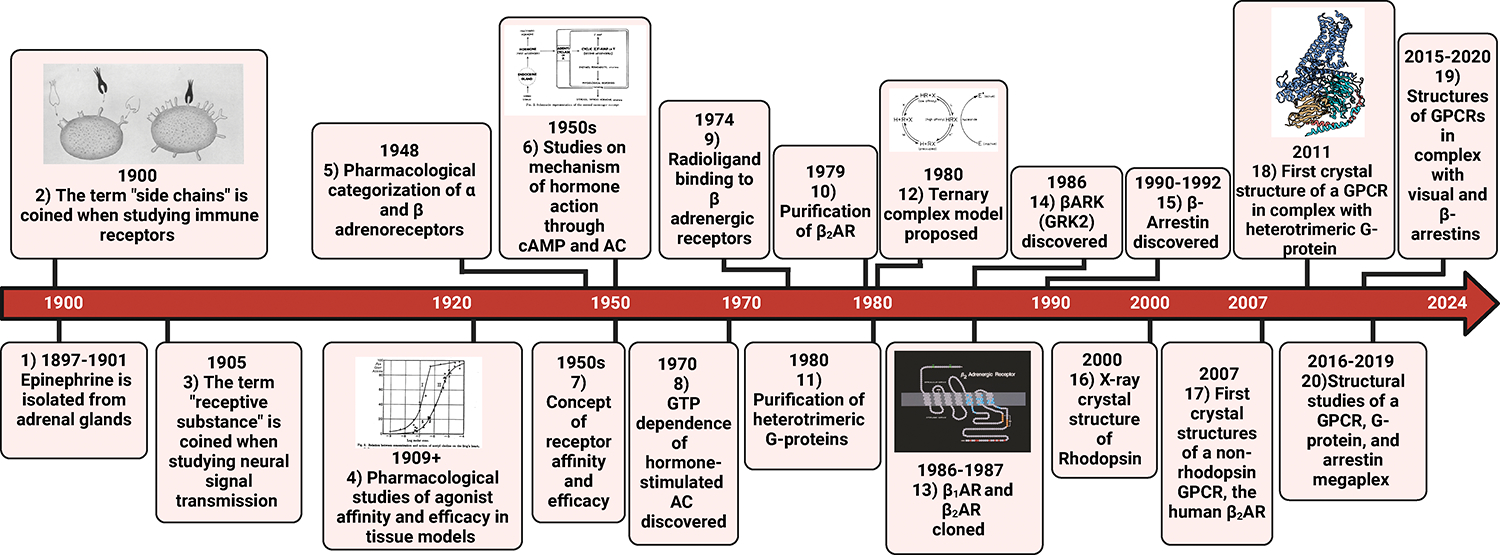
Over the past century, there have been many discoveries from ligands to transducers. Here we have highlighted key studies that have contributed to our knowledge of GPCRs. Below are the corresponding publications for each discovery. Images were reproduced with permission from reference #’s
1. 1897–1901: Epinephrine is characterized and isolated from adrenal glands.4,241 2. 1900: The term “side chains” is coined when studying immune receptors.7 3. 1905: The term “receptive substance” is coined when studying neural signal transmission.9 4. 1909+: Pharmacological studies of agonist affinity and efficacy in tissue models.15–18 5. 1948: Pharmacological categorization of α and β adrenoreceptors.242 6. 1950s: Studies on the mechanism of hormone action through cAMP and Adenylyl Cyclase (AC). 21,23,243 7. 1950s: Concept of receptor affinity and efficacy.19,20 8. 1971: GTP dependence of hormone-stimulated AC discovered.24–26 9. 1974: Radioligand binding of β adrenergic receptors.31–33 10. 1979: Purification of the β2AR.36 11. 1980: Purification of heterotrimeric G-proteins.27,28 12.1980: Ternary complex proposed.35 13. 1986–8: β1AR and β2AR cloned.37,244,245 14. 1986: βARK (GRK2) discovered.38 15. 1990–1992: β-arrestins discovered.39,40 16. 2000: X-ray crystal structure of Rhodopsin.246 17. 2007: First crystal structures of a non-rhodopsin GPCR, the human β2AR.191,192 18. 2011: First crystal structure of a GPCR in complex with heterotrimeric G-protein.193 19. 2015–2020: Structures of GPCRs in complex with visual and β-arrestins.247–249 20. 2016–2019: Structural studies of a GPCR, G-protein, and arrestin megaplex. 250,251